




Frequently Asked Questions
Test
Korntex is a German manufacturer and specialist in hi‑vis vests, protective clothing and safety apparel. Founded in 2007, the company develops high‑quality hi‑vis products for businesses, authorities, clubs and private customers. Headquarters are in Fellbach near Stuttgart. Korntex Suisse AG, as the 100% partner company for the Swiss market, offers a broad range of hi‑vis vests, functional vests, hi‑vis jackets, hi‑vis shirts and other personal protective equipment (PPE) such as beanies, caps and work and nitrile gloves. Many products meet EN ISO 20471 requirements and can be customized with company logos or advertising messages. Thanks to high stock availability, modern logistics and certified quality, Korntex is now one of the leading brands for protective clothing in Europe and supplies customers in many countries worldwide.
Korntex offers hi‑vis vests and safety clothing in a very wide size range. Depending on the model, products are available from XS to 7XL, so both slimmer and more robust people can find the right vest. Many models also feature Velcro or other adjustments for a tailored fit. For children’s hi‑vis vests, Korntex offers sizes XXS to S depending on the model. You can find the right size and exact measurements in the size chart on each product page.
Korntex hi‑vis vests stand for tested quality, high visibility and a wide selection of models for almost every application. Since 2007 Korntex has developed innovative protective garments and is now one of the leading specialists for hi‑vis vests, safety apparel and PPE in Europe. The range includes classic hi‑vis vests, children’s hi‑vis vests, mesh vests, zipped models and many colours and sizes. Many products are certified to EN ISO 20471, EN 17353, EN ISO 13688 or EN 343 and can be customized with your company logo.
Korntex safety vests are primarily manufactured at our own production facility in China. In-house production allows Korntex to ensure high quality standards and continuously monitor production and the supply chain. On request, we can also produce within Europe to reduce the CO2 footprint. All products are manufactured to strict quality standards and—depending on the model—meet the requirements of relevant norms such as EN ISO 20471, EN 17353, EN ISO 13688, or EN 343. They are then shipped worldwide to customers in Europe and many other regions.
Korntex hi‑vis vests and protective clothing are used across many industries, including construction, logistics, transport, industry, municipal services, rescue services, security, event organisers, clubs and schools. With a large product range, Korntex offers suitable solutions for professional users and leisure.
Korntex offers warning vests in a wide selection of colors. In addition to classic signal yellow and signal orange, the range includes red, green, blue, pink, purple, black, white and more—ideal for companies, events, clubs or promotions. Depending on the application, both certified warning vests and colored performance vests are available.
Yes. Korntex offers various warning vests with zippers. The zipper ensures a secure fit and makes them easier to put on and take off—especially with frequent use. Many models are EN ISO 20471 certified and suitable for construction, logistics, industry or events.
Yes. Korntex also supplies flame-retardant warning vests for workplaces with higher heat and flame protection needs. Depending on the version, these specialized models meet, in addition to visibility requirements, further relevant protective standards and are suitable for industry, energy supply or welding work.
One of Korntex’s most popular models is the Basic KXVW safety vest. It stands out for its high visibility, comfortable fit, and suitability for a wide range of applications. Also in high demand is the safety vest with 4 reflective stripes and a zipper, which offers a particularly secure fit and excellent wearing comfort. Both models are among the most frequently chosen safety vests for companies, authorities, and associations.
Farben2
Yes. The color of a warning vest matters. It helps people to be spotted early by day and in poor visibility. Certified high-visibility vests to EN ISO 20471 come in fluorescent colors such as yellow, orange or red and must also include reflective strips. Which color is right depends on the application. Yellow vests are common in industry, logistics and construction sites, while orange vests are especially used in roadworks and rail sectors. Some industries or companies may also have specific color requirements. Korntex Suisse AG offers warning vests and high-visibility clothing in various certified colors so you can find the right solution for every application.
A vest's visibility depends on colour, reflective tape and lighting conditions. Yellow vests are particularly visible, offering very high contrast in daylight and many environments. Orange vests are ideal for roadworks, rail areas or autumn landscapes, while red vests are used in certain work areas and rescue services. However, not only colour is decisive—the certification matters too. A safety vest compliant with EN ISO 20471 meets defined requirements for fluorescent material and reflective tape, ensuring high visibility in daylight, twilight and darkness. At Korntex Suisse AG you will find safety vests and high‑visibility clothing in various certified colours and versions. This helps you choose the right safety vest for your application and ensures maximum visibility and safety.
In Switzerland, yellow and orange hi‑vis vests are most commonly used. Both colours are permitted for protective clothing under EN ISO 20471 and, together with reflective tape, provide high visibility. Yellow hi‑vis vests are especially common in construction, logistics, transport and breakdown services. Orange vests are often used in roadworks, rail environments and by public services because they contrast well with certain backgrounds. However, colour alone isn’t decisive — the vest must be certified to EN ISO 20471 and suitable for the working environment. At Korntex you’ll find hi‑vis vests and protective clothing in the standard signal colours yellow and orange for maximum visibility and safety in Switzerland.
In Switzerland, carrying a hi‑vis vest in the car is not legally required, so there’s no mandated color. For safety, it’s still advisable to keep a highly visible yellow or orange vest in the vehicle. For trips abroad, the vest should comply with the destination country’s regulations. A certified vest meeting EN ISO 20471 (formerly EN 471) is recommended. Yellow and orange vests are common in Europe and ensure high visibility in breakdowns or accidents. It’s best to keep the hi‑vis vest within easy reach inside the vehicle so it can be put on before exiting.
Hi‑vis vests are fluorescent so they stand out in daylight, dusk and poor visibility. Fluorescent material converts invisible UV light into visible light, appearing much brighter than ordinary fabrics. Bright signal colors—usually yellow, orange or red—create strong contrast with the environment. This helps people be noticed earlier in traffic, on construction sites or in industry, reducing accident risk. Fluorescent color alone isn’t enough. Hi‑vis garments certified to EN ISO 20471 also include reflective tape. Fluorescent material boosts daytime visibility, while reflective strips return vehicle headlights at dusk and in the dark. At Korntex you’ll find hi‑vis vests and safety clothing made with high-quality fluorescent materials and reflective tape that meet EN ISO 20471 and ensure maximum visibility.
Alles rund um EAN und ISO
EN stands for European Standard. These standards set uniform requirements for product safety, quality and performance. For hi‑vis vests and protective clothing, EN standards specify what a product must meet to be suitable for its intended use. Key standards for hi‑vis include: If a hi‑vis vest is certified to one of these EN standards, it has been tested and meets the relevant European safety requirements. At Korntex you’ll find a wide selection of hi‑vis vests and protective clothing certified to the applicable EN standards that provide reliable protection at work.
ISO stands for International Organization for Standardization. It develops internationally recognized standards that set requirements for product quality, safety and performance. For hi‑vis vests and protective clothing, the term EN ISO indicates the standard is recognized both at European level (EN) and internationally (ISO). An example is EN ISO 20471, which specifies requirements for high‑visibility protective clothing, including how much fluorescent material and reflective tape a vest must have for optimal visibility. A vest certified to EN ISO gives you confidence that the product was tested to internationally recognized safety standards and meets the requirements for professional use.
The number of digits does not indicate the quality or importance of a standard; it simply uniquely identifies different standards. For safety vests and high-visibility garments, EN ISO 20471 is the key standard. It specifies requirements such as minimum areas of fluorescent material, the arrangement of reflective stripes and visibility classes. In short: 3-digit EN standards are European, while 5-digit EN ISO standards are based on international ISO standards that were adopted in Europe. What matters is not the number of digits but the requirements the specific standard imposes on the product.
EN ISO 20471 is the key standard for high‑visibility clothing. It specifies the requirements a vest must meet so that people can be seen as early as possible in daylight, twilight and darkness. The standard defines, among other things: A vest certified to EN ISO 20471 has been tested against applicable European and international safety standards and is suitable for professional use in areas like construction, logistics, industry, transport or roadwork. At Korntex you'll find a wide selection of EN ISO 20471 certified safety vests and high‑visibility clothing that meet the highest requirements for visibility, safety and quality.
EN ISO 20471 Class 1 is the lowest of the three visibility classes for hi‑vis clothing. It provides basic protection and is suitable for lower-risk areas where people still need to be visible. The classes 1, 2 and 3 are based on minimum areas of fluorescent material and reflective tape. The higher the class, the larger the visible surface and the greater the wearer’s visibility. Class 1 hi‑vis clothing is used in areas with low traffic speeds and lower hazard potential. Whether Class 1 is sufficient always depends on the risk assessment and applicable occupational safety rules. For many tasks in roadworks, construction sites, logistics or public traffic areas, Class 2 or Class 3 hi‑vis vests are required because they offer significantly greater visibility. At Korntex you’ll find hi‑vis vests and safety clothing according to EN ISO 20471 in Classes 1, 2 and 3—suitable for different applications and safety needs.
EN ISO 20471 class 2 is the middle of the three visibility classes for high‑visibility clothing. It offers greater visibility than class 1 and is often used for tasks where people need to be clearly visible in traffic, on construction sites, in logistics or in industry. Classification into class 1, 2 or 3 depends on the minimum area of fluorescent material and reflective tape. Class 2 garments have more warning material than class 1, improving detectability in daylight, twilight and darkness. Typical class 2 products include safety vests, hi‑vis shirts and hi‑vis polo shirts. In many sectors a class 2 vest already meets legal or company requirements. Which class is required always depends on the hazard assessment and applicable safety regulations. At Korntex you'll find a wide range of EN ISO 20471 class 2 safety vests and high‑visibility clothing, developed for professional use and offering an optimal mix of visibility, comfort and safety.
EN ISO 20471 Class 3 is the highest visibility class for hi‑vis clothing. It prescribes the largest areas of fluorescent material and reflective tape, making wearers highly visible by day, dusk and night. Class 3 hi‑vis clothing is used where there is a high hazard risk—such as roadworks, motorway work, rail areas, airports or other fast-moving traffic zones. Typical Class 3 products include: Compared with Class 1 and Class 2, EN ISO 20471 Class 3 offers the highest visibility and is recommended or required for the most safety-critical work areas. The required class always depends on the specific risk assessment and applicable safety regulations. At Korntex you’ll find EN ISO 20471 Class 3 hi‑vis clothing that meets the highest visibility, safety and comfort requirements.
EN 343 is the European standard for protective clothing against rain, snow, fog and moisture. It defines how well rain jackets, rain pants or other weatherproof protective clothing protect against wetness while remaining breathable. The standard assesses two key properties: The higher the performance values, the better the protection against rain and the more comfortable the garment is for longer use. Many Korntex high-visibility and rain jackets combine EN 343 with EN ISO 20471. This provides reliable protection from rain while also ensuring high visibility in poor weather and low light.
EN ISO 13688 is the basic standard for protective clothing. It sets general requirements for safety, comfort, ergonomics and labelling, but does not include specific protection requirements against particular hazards. The standard covers, among other things: EN ISO 13688 is generally combined with other protective standards. Many hi‑vis vests and protective garments from Korntex, for example, meet both EN ISO 13688 and EN ISO 20471. While EN ISO 13688 defines general requirements, EN ISO 20471 specifies visibility requirements. EN ISO 13688 forms the basis for high‑quality protective clothing and ensures that products are not only protective but also safe, comfortable and clearly labelled.
EN 17353 is the European standard for garments with increased visibility in medium-risk situations. It targets people who need to be more visible but for whom the requirements of EN ISO 20471 for professional high-visibility clothing are not necessary. The standard applies, for example, to: EN 17353 sets requirements for using fluorescent materials, reflective elements or a combination of both. The goal is to improve visibility in daylight, twilight and darkness. Unlike EN ISO 20471, EN 17353 is not intended for high-risk workplaces. For roadworks, construction sites, logistics or industrial activities, high-visibility clothing meeting EN ISO 20471 is typically required. Korntex offers both high-visibility vests according to EN ISO 20471 and products to EN 17353, so you can choose the right solution for visibility and safety depending on your application.
EN 17353 also applies to children’s hi‑vis vests. It covers garments with increased visibility for medium-risk situations and is ideal for children’s everyday use—such as the walk to school, outings, cycling, walks or recreational activities in poor light. Unlike EN ISO 20471, which was developed for professional high-visibility clothing in work environments, EN 17353 is specifically designed for non‑professional use. It ensures children’s hi‑vis vests use fluorescent materials and reflective elements to significantly improve visibility in daylight, twilight and darkness. For children, a hi‑vis vest certified to EN 17353 is the right choice when improved visibility is needed in traffic or during leisure activities. Korntex offers a range of children’s hi‑vis vests according to EN 17353 to increase safety and visibility in everyday life.
The CE marking on a hi‑vis vest shows the product meets the EU’s safety, health and environmental protection requirements. For protective clothing, it means the vest has been tested and placed on the market as PPE under the EU Regulation. The CE mark alone does not indicate the intended use. The specific standard is decisive, for example: A high‑quality hi‑vis vest therefore carries both the CE mark and the relevant standard and — where applicable — the protection class (Class 1, 2 or 3). At Korntex you’ll find CE‑marked hi‑vis vests and protective clothing certified to the applicable European standards that meet stringent visibility and safety requirements.
EN 17353 is sufficient when professional high-visibility clothing is not required and increased visibility for everyday situations or medium-risk scenarios is adequate. Typical areas of use include: EN 17353 was developed for people who need to be more visible in traffic or poor light. Depending on the design, the garments combine fluorescent materials, reflective elements or both to improve visibility during the day, at dusk and at night. For workplaces with higher hazards—such as construction sites, roadworks, logistics, transport or industry—EN 17353 is generally not sufficient. In these cases, high-visibility clothing according to EN ISO 20471 is usually required. If you’re unsure which standard is required for your area of use, we’re happy to advise you on choosing the right hi‑vis vest or high-visibility clothing.
Yes — if a hi‑vis vest is sold as Personal Protective Equipment (PPE) and intended to protect people, it must bear the CE mark. The CE mark confirms the vest meets the requirements of EU Regulation 2016/425 on PPE and has been appropriately tested. A CE‑marked hi‑vis vest is typically also certified to a recognized standard, for example: However, the CE mark alone is not enough. Also check the stated standard, the protection class (for EN ISO 20471) and the manufacturer’s label. That ensures the vest is suitable for the intended use. At Korntex you’ll find CE‑marked hi‑vis vests and protective clothing that comply with the applicable European standards and meet high visibility and safety requirements.
Bedrucken und Veredeln
Several printing methods are available for printing hi‑vis vests, protective apparel and functional vests. The choice depends on material, quantity, ink and the desired outcome. The most common printing methods are: We’ll gladly advise which printing method best suits your garments and design.
The right printing method depends on material, design and quantity. We’re happy to recommend the optimal solution for your hi‑vis vests or workwear.
There’s no fixed quantity because design size, number of print colours and print positions also matter. As a guideline: We review every request individually and recommend the most cost-effective printing method.
Setting up the machines, preparing print files and positioning the motif require almost the same effort regardless of whether one or a hundred items are printed. That setup effort is distributed across more garments for larger quantities.
Among Korntex’s most popular models is the Warning Vest Basic KXVW. It stands out for its high visibility and comfortable fit and is suitable for many applications. The zipper vest with four reflective stripes is also in high demand, offering a secure fit and excellent comfort. Both models are frequently chosen by companies, authorities and clubs.
Yes, many safety helmets can be customized with special films or stickers. Whether direct printing is possible depends on the helmet material and its approval. It's best to contact us—we're happy to advise you.
Why do I have to provide a vectorized file?
AI, EPS, PDF (vector), and SVG are the most commonly used formats.
Die costs are one-time setup charges for creating the printing plate or template, for example in screen printing or pad printing. They only apply to certain printing methods.
Custom‑printed hi‑vis vests and workwear are made to customer specifications and are generally excluded from returns and exchanges—except for manufacturing defects or justified complaints.
Yes—printing can affect certification if too much fluorescent material or reflective tape is covered. Logos and print areas must be placed so EN ISO 20471 requirements remain met. A professional print service will take these rules into account during design.
The choice of print colour depends on the colour of the safety vest or functional vest and the desired contrast. High contrast ensures logos, lettering and messages are easy to read. Recommendations for the most common vest colours: For safety vests, black prints are often used because they offer the best contrast on yellow and orange backgrounds. If you also want the logo to be visible at night, a silver reflective print is recommended. With mesh safety vests or vests with reflective tape, the print position should be chosen carefully so legibility is preserved and EN ISO 20471 requirements are not compromised.Colour of the safety vest Recommended print colour Yellow Black, dark blue or dark green Orange Black or dark blue Red White, black or silver Blue White or silver Green White or black Pink Black or white Black White, silver or reflective silver
Most hi‑vis, safety and functional vests can be printed. The suitable printing method depends on the material, surface and desired design. Polyester vests are especially suitable, while mesh vests require special printing techniques due to their breathable fabric. To maintain EN ISO 20471 certification, logos and prints must be placed correctly. We review every design and recommend the suitable printing method for a durable, high‑quality result.
For printing, vests with large, solid printing areas are best. Classic polyester safety vests provide the best surface for company logos, lettering, or promotional messages. Mesh safety vests can also be printed. Due to the breathable net material, not all printing methods and designs are equally suitable. We are happy to advise you on selecting the right safety vest and optimal printing method.
A company logo can be placed on the chest, the back or both. A small logo on the left chest and a larger logo or lettering on the back are especially popular. It is important that reflective strips and fluorescent areas are not covered. This is the only way to preserve visibility and continue to meet EN ISO 20471 requirements.
There’s no universally fixed maximum logo size. What matters is that printing doesn’t cover too much fluorescent material or reflective strips. For hi‑vis vests certified to EN ISO 20471, the minimum area of warning material must remain. We therefore assess each logo size individually.
Yes. Many companies choose a chest logo and a text line or large logo on the back. Sleeve or side prints are possible depending on the model. Important: placement must not reduce visibility or affect certification of protective garments.
High-quality transfer prints, screen prints and digital transfer prints offer long durability and good wash resistance. Which method is most durable depends on the material, use and care of the warning vest. With proper care, prints remain attractive for many years.
Yes. Existing high-visibility vests can often be printed afterwards with a company logo, name or text, provided the material is suitable for the chosen printing method and the vest's protective function isn’t compromised.
Yes. Company names, logos, slogans, department designations or individual names can usually be applied to most warning vests. Printed high-visibility vests create a professional appearance and increase your organization’s recognizability.
Alles rund um Kinderwesten
Children's safety vests generally follow EN 17353. This European standard sets requirements for high‑visibility clothing for non‑professional use. It's ideal for children on the way to school, cycling, outings or leisure activities where visibility is important. By contrast, EN ISO 20471 is designed for professional high‑visibility clothing in the workplace and is primarily aimed at adults. Since children do not perform occupational tasks requiring PPE, EN 17353 is the appropriate standard for them. Children's safety vests to EN 17353 use fluorescent materials and reflective elements to make children more visible in daylight, twilight and darkness. Korntex offers children's safety vests to EN 17353, designed to increase visibility and safety for everyday use, the school run and leisure.
Yes, your child can wear a pink hi‑vis or functional vest—but consider the intended use. For maximum visibility in traffic, a children’s hi‑vis vest to EN 17353 is recommended. This standard ensures the vest meets requirements for increased-visibility garments. Not every pink vest meets this norm. Pink functional vests are suitable for outings, events or group identification. However, for school routes, cycling or road traffic, a certified children’s hi‑vis vest to EN 17353 in a standard signal color is the safer choice. When buying, focus not just on color but on certification, reflective strips and a good fit. That way your child will be as visible as possible by day, at dusk and at night.
The correct size for a child's high-visibility vest is determined primarily by the child's height. A well-fitting vest should be worn comfortably over clothing, allow enough movement and be neither too tight nor too loose. Many Korntex Kids Warning Vest models are available in sizes XXS to S and cover different age and height ranges. Exact measurements vary by model, so we recommend checking the product's size chart before buying. For the school run, cycling or leisure, a children's high-visibility vest to EN 17353 is suitable; it is specifically designed for increased visibility in non‑professional contexts. This helps make your child more visible in daylight, dusk and darkness. Tip: If your child is between sizes or will wear the vest over a thick jacket, choose the next size up.
Warnwesten
The right high-visibility vest depends on the application. For professional use, a vest certified to EN ISO 20471 is recommended. For leisure or events, a functional vest may be sufficient.
The main difference is in certification and intended use. A high-visibility vest is protective apparel certified to a standard such as EN ISO 20471 or—for children’s hi‑vis vests—EN 17353. It’s made of fluorescent material with reflective strips and is designed to significantly increase visibility and safety in road traffic and at work. High-visibility vests are used in construction, logistics, transport and breakdown assistance, among other areas. A functional vest is primarily used for identifying people or groups. It’s commonly used at events, in sports, schools, kindergartens or by stewards, volunteers and response teams. Functional vests come in many colors and can be custom printed with logos or lettering. They often include reflective elements but are not automatically certified as high-visibility safety clothing. If a vest is intended as personal protective equipment and must meet legal requirements, a certified high-visibility vest is the right choice. For simple color-based identification of teams or people, a functional vest is often sufficient.
Construction sites typically require safety vests certified to EN ISO 20471. Which protection class is required depends on the risk assessment.
For warehousing, transport and logistics, high-visibility vests in Class 2 or 3 are generally used.
For events, functional vests are often used, as they come in many colors and can be custom printed.
Certified hi‑vis vests meet a recognized European standard and are tested as Personal Protective Equipment (PPE). The required certification depends on the intended use. The most important standards are: You can recognise a certified hi‑vis vest by: At Korntex you’ll find a wide selection of certified hi‑vis vests, children’s hi‑vis vests and protective clothing that comply with the applicable European standards and are designed for different uses.
PPE stands for Personal Protective Equipment. This includes garments and equipment that protect employees from health and safety risks at work. A hi‑vis vest is considered PPE if it’s tested and certified according to applicable regulations. A hi‑vis vest as PPE typically meets the requirements of EN ISO 20471 and bears a CE mark. It helps wearers be more visible by day, dusk and night, reducing the risk of accidents. Typical application areas for PPE hi‑vis vests include: Not every vest is automatically Personal Protective Equipment. Functional vests or simple signal vests without certification often serve only to identify people or groups and do not meet PPE requirements. At Korntex you’ll find PPE-certified hi‑vis vests and safety clothing that meet applicable European standards and are designed for professional use.
No. Not every high-visibility vest is personal protective equipment (PPE). A vest is only PPE if it has been tested under the applicable European rules, bears a CE mark and is certified to the relevant standard. A PPE high-visibility vest typically complies with EN ISO 20471 and is intended for professional use in areas such as construction, logistics, industry or roadwork. It provides high visibility and helps reduce accident risk. There are also functional or signal vests that serve only to identify people or groups. These vests may have bright colours or reflective elements but do not automatically meet personal protective equipment requirements. When buying, look for the following features: At Korntex you’ll find PPE-certified high-visibility vests for professional use as well as functional vests for events, clubs, schools and other applications.
Funktionswesten
A functional vest is a lightweight vest for identifying people or groups. It’s commonly used at events, sports, trade shows, schools, clubs or in companies. Unlike a hi‑vis vest, it primarily serves identification and is not automatically certified as PPE. Korntex offers functional vests in many colors, sizes and styles. Many models are ideal for printing company logos, club names or custom designs.
Functional vests are used wherever people need to be quickly identified or assigned to groups. Typical uses include events, trade shows, sports events, schools, kindergartens, clubs, rescue drills, promotions or internal organisation. With a wide range of colours and options for custom printing, functional vests enable clear identification and a professional appearance.
No. Performance vests are generally not personal protective equipment (PPE). They are used for identifying people and do not replace certified high-visibility protective clothing. If increased visibility is required for a task, a warning vest conforming to EN ISO 20471 or, depending on the application, a vest meeting EN 17353 should be used instead.
Yes. Some performance vests include reflective stripes or piping to improve visibility. That doesn’t automatically mean the vest is certified as protective high-visibility clothing; what matters is whether it meets standards like EN ISO 20471 or EN 17353.
Yes. Performance vests are excellent for printing company logos, club names, text or advertising messages. The large print areas allow both a chest logo and a large back print to be applied easily.
Korntex offers performance vests in a wide range of colors. Besides yellow and orange, depending on the model you can also choose blue, red, green, black, white, pink, purple, light blue and other colors. This makes it easy to differentiate teams, departments or visitors.
Most functional vests are available in sizes from XS to 7XL. In addition, Korntex offers Korntex Kids Warning Vest sizes for schools, clubs and events. Available sizes may vary by model.
Most functional vests are made of lightweight, durable polyester. The fabric is easy to care for, comfortable to wear and ideal for daily use and for printing or other finishing.
Yes. Performance vests are generally machine washable. Always follow the manufacturer's care instructions, especially for printed vests, to preserve colors and prints.
Functional vests are used by event organisers, security services, schools, kindergartens, sports clubs, event agencies, industrial companies, warehouses and rescue organisations. They make it easy to identify staff, helpers or visitors quickly.
A functional vest is used to identify people or groups and comes in many colors. A hi‑vis vest increases visibility and—depending on the model—can be certified as personal protective equipment (PPE) under EN ISO 20471 or EN 17353. Functional vests do not replace hi‑vis workwear when that is required by law or risk assessment.
Yes. Performance vests can be customized with logos, names, numbers or promotional messages. That makes them ideal for companies, clubs, events, promotions or sports events and creates a consistent, professional appearance.
Multifuktionswesten
A multi‑pocket vest is a vest with numerous pockets and practical features for professional or private use. It provides storage for tools, radios, badges, smartphones and other items so essentials are always within reach. Korntex multi‑pocket vests are ideal for construction sites, logistics, events, security services, trades, industry and many other areas. Some models are also available as hi‑vis vests compliant with EN ISO 20471, combining comfort with optimal visibility.
Multifunction vests are used wherever good visibility and ample storage are needed. They’re commonly used in construction, logistics, security services, events, industry, emergency organizations and trades. With numerous pockets and practical features, tools and work items can be carried on the body comfortably without extra pouches or belts.
A multi‑pocket vest brings together comfort, organization and functionality in one garment. Multiple pockets and attachment points let you store tools, ID and communication devices securely and neatly. Many models also offer high visibility and meet EN ISO 20471. This makes multi‑pocket hi‑vis vests ideal where both safety and practical features are needed.
Depending on the model, multifunction vests feature multiple internal and external pockets for tools, documents, smartphones, radios or IDs. The exact number and equipment vary by version.
Yes. Korntex offers multifunction warning vests certified to EN ISO 20471. These combine high visibility with functional pocket layouts and are suitable for professional use.
Yes. Many multifunction vests can be printed with a company logo, name or text while ensuring pockets, zippers and—on certified models—the protective functions are not affected.
Multifunction vests are frequently used in construction, logistics, transport, security services, trades, industry, at events and by authorities and rescue organizations. Wherever workers need tools or materials within easy reach, they provide real added value.
Most multi‑function vests are made from robust polyester or hard‑wearing blends. These materials are long‑lasting, easy to care for and designed for everyday use.
Yes. Most Korntex multifunction vests feature a robust zipper that ensures a secure fit and simplifies putting them on and taking them off. Some models also include Velcro closures or other practical details.
A classic hi‑vis vest primarily provides visibility and—depending on the model—meets EN ISO 20471 or EN 17353. A multi‑pocket vest also offers many pockets and functional features for tools and work items. Many Korntex models combine both and are available as multi‑pocket hi‑vis vests.
Kennzeichnungswesten
An identification vest is designed to make people or groups quickly and clearly identifiable. It’s used at events, in companies, schools, on construction sites, during rescue drills or in sports. Different colors or prints allow roles, teams or responsibilities to be recognized at a glance. Unlike a hi‑vis vest, an identification vest is not automatically certified as PPE. If visibility for protection is the priority, you should use a hi‑vis vest compliant with EN ISO 20471 or EN 17353.
Identification vests are used wherever people need to be quickly recognised or assigned specific tasks. Typical applications include events, trade shows, schools, sports events, security services, first‑aid teams, evacuation helpers, visitor groups or internal organisation. Different colours and custom printing create clear structures and make orientation easier for both staff and visitors.
Yes—identification vests are ideal for custom printing with company logos, club names, role labels or numbers. Common prints include “Security,” “Visitor,” “Organiser,” “Press,” “First Aid” or the company name. With large print areas on the chest and back, identification vests can be customized to suit specific roles and applications.
No. Identification vests are primarily for identifying people and are generally not personal protective equipment (PPE). If high-visibility protection is required for a task, use a certified warning vest to EN ISO 20471 or EN 17353 instead.
Korntex offers identification vests in many colors, including yellow, orange, red, blue, green, pink, purple, black and white. This lets teams, departments or roles be clearly distinguished.
Identification vests are used by companies, authorities, schools, clubs, event organisers, security services, rescue organisations and industrial operations. They’re suitable wherever people need quick identification or role assignment.
Yes. Identification vests can be printed with logos, names, job titles or custom text. They’re ideal for events, trade shows, businesses or clubs and provide a professional, uniform look.
An identification vest is specifically made to clearly mark people or roles—using colors or prints like “Security,” “Visitor” or “Organization.” A functional vest is more general and often used for events, promotions or clubs. Both types serve identification and are usually not PPE. If increased visibility is required, choose a hi‑vis vest certified to EN ISO 20471 or EN 17353.
Einsatzwesten
A tactical vest is a functional vest with many pockets, loops and attachment points for equipment and work materials. It provides quick access to items like radios, documents, flashlights or first aid supplies and ensures organized gear during operations. Korntex tactical vests are suitable for security services, event management, rescue services, authorities and many other professional fields. Depending on the model, they can be customized with a logo or role designation.
Tactical vests are used wherever equipment must be carried securely, accessibly and comfortably. Typical areas include security services, event management, rescue services, civil protection, authorities, industry and technical response teams. Their functional features make daily work easier and ensure essential items are quickly available.
Are tactical duty vests personal protective equipment (PPE)? Normal workwear is mainly intended to protect clothing, provide comfort and present a professional appearance. Hi-Vis workwear additionally uses fluorescent materials and reflective strips to greatly increase visibility.
Yes. Tactical duty vests can be printed with company logos, organization names or function labels such as “Security”, “Event”, “Rescue Service” or “Incident Command.” This makes staff or responders recognizable at a glance.
Depending on the model, tactical duty vests provide space for radios, smartphones, IDs, documents, flashlights, gloves, notepads, writing tools or first-aid kits. Multiple pockets and attachment points keep gear well organized.
Tactical vests are used by security services, event organizers, rescue organizations, authorities, industrial companies, technical response teams and in civil protection. They’re useful wherever staff need to carry equipment on their bodies for fast access.
Most tactical duty vests are made from tough, durable polyester or resilient blends. The materials are long‑lasting, easy to care for and designed for heavy-duty use. Korntex also offers a mesh version for summer use
Yes. Korntex offers tactical duty vests in various sizes. Many models also feature adjustable fastenings or straps so they can be tailored to the wearer and comfortably worn over other clothing.
Nachhaltigkeit
Yes—safety vests can generally be recyclable. Most safety vests are made from polyester, a plastic that can be recycled under suitable conditions. Whether a vest is actually recycled depends on its material, condition and the capabilities of the local disposal system. Printed safety vests or models with zippers, Velcro or other material combinations may need to be separated or specially processed before recycling. More and more manufacturers—including Korntex—also offer sustainable high‑visibility vests made from recycled polyester (rPET). These help conserve resources and reduce the use of new plastics.
An old safety vest should be disposed of according to local regulations. Since most safety vests are mainly polyester, they usually don't belong in the home compost but should go to designated textile or plastic collection and disposal channels. If the vest is still in good condition and still meets safety requirements, it can often be reused or donated. Heavily soiled, damaged or non‑compliant vests should be properly disposed of and replaced. For large quantities of high‑visibility clothing, it's worth asking about special take‑back or recycling programmes.
Yes. Sustainable warning vests made from recycled polyester (rPET) are available. For example, used PET bottles are processed into new fibers, reducing raw material consumption and conserving resources. Sustainable high-visibility vests meet the same safety requirements as conventional vests depending on the model, and can also be certified to EN ISO 20471 or EN 17353. This means you don’t have to compromise on visibility and safety. Korntex offers various warning vests made from recycled materials and continuously expands its range with sustainable solutions for companies, authorities and organizations that value environmental responsibility and quality.
A hi‑vis vest should be replaced as soon as its visibility or protective effect decreases. Damage, heavy soiling, faded colors or damaged reflective strips can greatly reduce recognizability and prevent the vest from fully performing its protective function. Replace your hi‑vis garments especially when: There’s no fixed lifespan. It depends on the vest’s condition, frequency of use and proper care. Check your hi‑vis garments regularly and replace them when in doubt so they continue to meet EN ISO 20471 or EN 17353 requirements and keep you visible.
A vest's durability depends on quality, usage and proper care. There is no universal lifespan. What's important is that the fluorescent properties and reflective tape function are retained. With regular use, safety vests and high‑visibility clothing should be checked regularly for damage, discoloration or worn reflective tape. Frequent washing, strong UV exposure or mechanical stress can reduce visibility over time. Many manufacturers provide a recommended maximum number of wash cycles or guidance on lifespan. As soon as a vest shows visible wear or no longer meets EN ISO 20471 or EN 17353, it should be replaced. With proper care and regular checks, your high‑visibility clothing will remain ready for use and provide the required visibility and safety.
Arbeitskleider
Workwear are specially designed garments for professional use. They protect regular clothes, increase comfort and support employees in daily tasks. Depending on the industry, workwear can offer durability, weather protection or increased visibility. Korntex offers a wide selection of workwear for industry, trades, logistics, construction, transport and other sectors. The range includes vests, jackets and other functional garments for professional use.
Workwear provide a consistent appearance, protect clothing during work and offer additional functions depending on the application. They are used in construction, logistics, industry, trade, workshops and service companies. The right workwear helps increase comfort and equips employees optimally for their tasks.
Yes. Most workwear can be printed with a company logo, name or text. Branded workwear reinforces a professional corporate image and increases recognition among customers and employees. Depending on the material and quantities, different printing methods are used such as heat transfer, digital transfer or screen printing.
Hi‑vis workwear is clothing with high visibility that reduces the risk of accidents in areas with vehicle traffic or poor visibility. This includes hi‑vis jackets, hi‑vis vests, trousers and other protective garments. Many hi‑vis workwear items meet the requirements of EN ISO 20471 and are suitable for professional use in construction, logistics, roadworks, airports or industry.
Hi‑vis workwear is required when a risk assessment calls for increased visibility or when legal or company rules prescribe it. Typical areas include construction sites, roadworks, logistics centres, airports, rail companies and work in public traffic areas. Which protection class is needed depends on the working conditions and the requirements of EN ISO 20471.
Many Hi-Vis workwear items are certified to EN ISO 20471 and are classed as personal protective equipment (PPE). They are used wherever employees need to be clearly visible in low light or around vehicles. What is the difference between workwear and Hi-Vis workwear?
For warm temperatures, lightweight and breathable workwear is suitable; these garments provide comfortable wear even in high heat. Materials like polyester or blends wick moisture well and dry quickly. Depending on the application, lightweight vests, T-shirts or other airy workwear are the ideal choice. If you work in areas with increased hazards, choose hi-vis workwear or high-visibility clothing meeting EN ISO 20471, which ensures optimal visibility even in summer.
In winter, work clothing should reliably protect against cold, wind and moisture. Padded vests, softshell jackets or weatherproof work jackets provide good comfort and keep the body warm in low temperatures. For outdoor work or areas with vehicle traffic, hi‑vis workwear certified to EN ISO 20471 is recommended. Many models combine weather protection, insulation and high visibility in a single garment.
Proper care extends the life of your workwear and preserves its function. Always follow the manufacturer's care instructions and wash garments with suitable detergents at the recommended temperature. Avoid harsh bleaches and high tumble-dryer temperatures as they can damage materials and prints. For hi‑vis workwear, correct care is especially important to maintain fluorescent materials and reflective tape.
Korntex offers workwear in a wide range of sizes. Depending on the model, sizes from XS to 7XL are available so both women and men can find the right fit. Available sizes may vary by product—consult the product size chart.
Most workwear garments are made from polyester, cotton or hard‑wearing blends. Depending on the application, materials may be chosen for extra durability, breathability, water resistance or easy care. The choice depends on the workplace requirements.
Yes. Increasingly, workwear is made from recycled materials such as recycled polyester (rPET). Sustainable workwear conserves resources while still offering the comfort and durability required for daily use.
The lifespan of work clothing depends on material, usage, care and wear. High-quality workwear can last many years with proper use and care. Damaged or heavily worn garments should be replaced, especially if they provide protection.
Workwear is used across almost all industries, including construction, trades, industry, logistics, transport, municipal services, security, warehouses, and event and service teams. Different functions and protection levels are available depending on the task.
Yes. For outdoor work there are waterproof workwear items that reliably protect against rain and moisture. Many models are also breathable and provide high wearing comfort. For areas that require visibility there are waterproof Hi-Vis garments which, depending on the model, meet EN 343 and EN ISO 20471.
Yes. Many workwear pieces include practical pockets for tools, smartphones, ID cards or other work items. Multifunction vests and work vests with multiple interior and exterior pockets in particular provide ample storage and make daily tasks easier by keeping essential items within reach.
Hi‑vis workwear is available in many designs to ensure high visibility at the workplace. The range includes hi‑vis vests, jackets, softshells, rainwear, multifunction vests and other professional protective garments. Depending on the task and environment, there are lightweight summer models, insulated winter garments or waterproof options. Many hi‑vis workwear items meet EN ISO 20471 and suit construction, logistics, industry, roadworks or transport.
All Hi-Vis workwear certified to EN ISO 20471 meets the requirements for high-visibility protective clothing. Depending on the model and intended use, products are available in classes 1, 2, or 3, with class 3 providing the highest level of visibility protection. You can find which certification a product meets in its product description or on the label. When buying, make sure the Hi-Vis workwear is suitable for your intended use.
The required protection class depends on your workplace risk assessment and applicable legal or company rules. Class 1 is suitable for low‑risk work environments. Class 2 is commonly used in logistics, industry and on construction sites. Class 3 offers the highest protection and is recommended for work in road traffic, on motorways or in high‑risk locations. If you’re unsure which hi‑vis garments you need, we’re happy to advise you on selecting the right protective clothing.
Yes. Many Hi-Vis garments can be printed with a company logo, name or text. Care must be taken not to cover reflective strips or fluorescent areas to maintain visibility and continue to meet EN ISO 20471 requirements.
A logo can affect certification if the print covers too much fluorescent material or reflective tape. If the logo is properly positioned and the required minimum areas remain, the certification of the hi‑vis garment stays valid. Therefore, finishing should always be done by an experienced specialist.
Yes. Many Hi-Vis garments are offered in women’s cuts. They provide an ergonomic fit and high comfort without compromising on safety or visibility. Where certified, these models also meet the requirements of EN ISO 20471.
Yes. For cold conditions there are Hi-Vis winter garments such as insulated jackets, softshell jackets and thermal vests. They protect against the cold while maintaining high visibility. Many winter models are EN ISO 20471 certified and suitable for outdoor use.
Yes. Waterproof Hi-Vis garments protect reliably against rain and bad weather. Many models meet EN ISO 20471 and additionally EN 343 for protection against rain, offering a combination of weather protection, breathability and high visibility.
To preserve the protective effect of hi‑vis clothing, wash according to the manufacturer’s care instructions. Use suitable detergents and avoid bleaches or harsh fabric softeners, as these can damage fluorescent materials and reflective strips. Check garments regularly for wear or damage so they continue to meet EN ISO 20471 requirements.
Hi‑vis workwear should be replaced as soon as its protective function is no longer ensured. Faded fluorescent colours, damaged reflective tape, rips or heavy wear can significantly reduce visibility. Also replace garments when the manufacturer’s recommended number of wash cycles is reached or when they no longer meet EN ISO 20471 requirements. Regular visual checks help ensure your protective clothing always provides the required protection.
Grössen und Passform
The correct vest size ensures comfort and that the vest can perform its protective function. A vest should be worn comfortably over normal clothing or a jacket without restricting movement. Korntex offers high-visibility vests in a wide size range—depending on the model from XS to 7XL. To find the right size, compare your measurements with the product's size chart. Since fit varies by model, check the individual size details. Tip: If the vest will regularly be worn over a winter jacket or thick workwear, choosing the next size up is often better. This preserves mobility and ensures the high-visibility garment fits comfortably over multiple layers.
The right size provides comfort, freedom of movement and optimal function. Measure your body and compare with the product's size chart to ensure your workwear or hi‑vis gear fits properly. If clothing is worn over a jacket or multiple layers, consider sizing up depending on the model.
Yes. Korntex sizes for workwear, high-visibility garments and warning vests follow common European sizing. Since fit can vary by product, we recommend checking the size chart for the specific model before buying.
Yes. Many Korntex workwear and Hi-Vis garments are available in a wide size range. Depending on the model, sizes run from XS to 7XL, covering both small and larger fits.
Material
Most high‑visibility and safety vests are made from 100% polyester. The fabric is lightweight, durable, easy to care for and comfortable to wear. Polyester is also excellent for fluorescent colours and reflective elements that ensure good visibility. Different fabrics are used depending on the model. Classic polyester fabrics are particularly durable, while mesh safety vests use a breathable net material that improves moisture transport and is ideal for warm conditions. For environmentally conscious companies and organisations there are also high‑visibility vests made from recycled polyester (rPET). These offer the same functionality and—depending on the model—can also meet EN ISO 20471 or EN 17353 requirements. Which material is best for your safety clothing depends on the application, weather conditions and desired product properties.
Rund ums Waschen und Pflegen
When is printing not worthwhile? Always wash your warning vest according to the care instructions on the label. Use a mild detergent and follow the recommended wash temperature to preserve fluorescent colors and reflective strips as long as possible.
The maximum number of washes depends on the model and the manufacturer's instructions. Many high-visibility vests are designed to tolerate multiple washes before visibility decreases. Always follow the manufacturer's care instructions. If a high-visibility vest reaches the recommended wash limit or shows signs of wear, it should be replaced.
Whether a warning vest is suitable for tumble drying is shown on the care label. High temperatures can damage fluorescent materials and reflective strips and shorten the service life of the protective clothing. In most cases air drying is the gentlest method to preserve a warning vest’s visibility and function over the long term.
In most cases ironing is not recommended. Heat can damage reflective strips and synthetic fibers. Always follow the care instructions on the label.
Frequent washing, intense UV exposure, dirt and normal wear can cause fluorescent colors to fade over time. Damaged reflective strips also reduce visibility. Once a warning vest no longer reliably performs its protective function, it should be replaced.
Yes. After washing, check the warning vest for damage, tears, loose reflective tape or severe fading. If visibility is impaired, the protective vest should be replaced.
Rechtliches
No. Switzerland has no general legal requirement for drivers to wear a safety vest. However, it is recommended to carry one in the vehicle and to put it on when exiting the vehicle on a road or motorway. This increases your visibility and reduces the risk of accidents. When travelling abroad, check the local regulations in advance since many European countries have a legal requirement to carry a safety vest.
Whether a safety vest must be worn depends on the work environment and applicable regulations. In the workplace, high-visibility clothing is often required when a risk assessment calls for increased visibility — for example on construction sites, roadworks, in logistics or where vehicle traffic is present. For professional use, the high-visibility vest should meet the requirements of EN ISO 20471.
Hi‑vis vests must meet different requirements depending on the application. For professional use, EN ISO 20471 typically applies for high-visibility workwear. For non-professional uses, such as cycling or school routes, EN 17353 can be relevant. Which regulations apply depends on legal requirements, company rules and the specific risk assessment.
Yes, if sold as personal protective equipment (PPE). CE marking confirms the vest meets the EU PPE regulation. An applicable standard such as EN ISO 20471 or EN 17353 should also be specified.
Welche Westen für Evakuation EVAK?
For well-organised evacuations (EVAK), use identification vests in different colours or with clear function prints so responsible persons can be recognised and tasks assigned quickly. Typical roles within an EVAK organisation include: Evacuation leaders Evacuation assistants Fire safety marshals First aid Security service Incident command Visitor services Technical support Communications Assembly point leaders Korntex offers identification vests, functional vests and, on request, high-visibility vests that can be printed with function labels or company logos. Different colours and legible back prints ensure responders are instantly recognisable even in chaotic situations. For operations in road traffic or other areas with increased risk, we also recommend high-visibility vests to EN ISO 20471 to ensure clear identification and high visibility.
There are no legally prescribed colours for EVAK roles. However, a consistent colour scheme improves orientation in an emergency and ensures responsible persons are recognised immediately. The following assignments have proven effective for clear EVAK organisation: For optimal recognition, identification vests should also have clear function prints such as “Incident Command”, “Evacuation Assistant”, “Fire Safety Marshal”, “First Aid”, “Technical Support”, “Communications”, “Visitor Services”, “Security”, “Management”, “Assembly Point Leader”, “Assembly Point Assistant” or “Traffic Control”. Korntex supplies identification and functional vests in many colours and prints them with your desired function labels or company logos. This helps create a consistent, professional EVAK concept where all responsible people are visible at a glance.Colour Function White Incident command Yellow Management Magenta Evacuation assistants Red Fire safety marshals Blue First aid / medical service Grey Technical support Violet Communications Light blue Visitor services Black Security Dark green Assembly point leader Light green Assembly point assistant Orange Traffic control 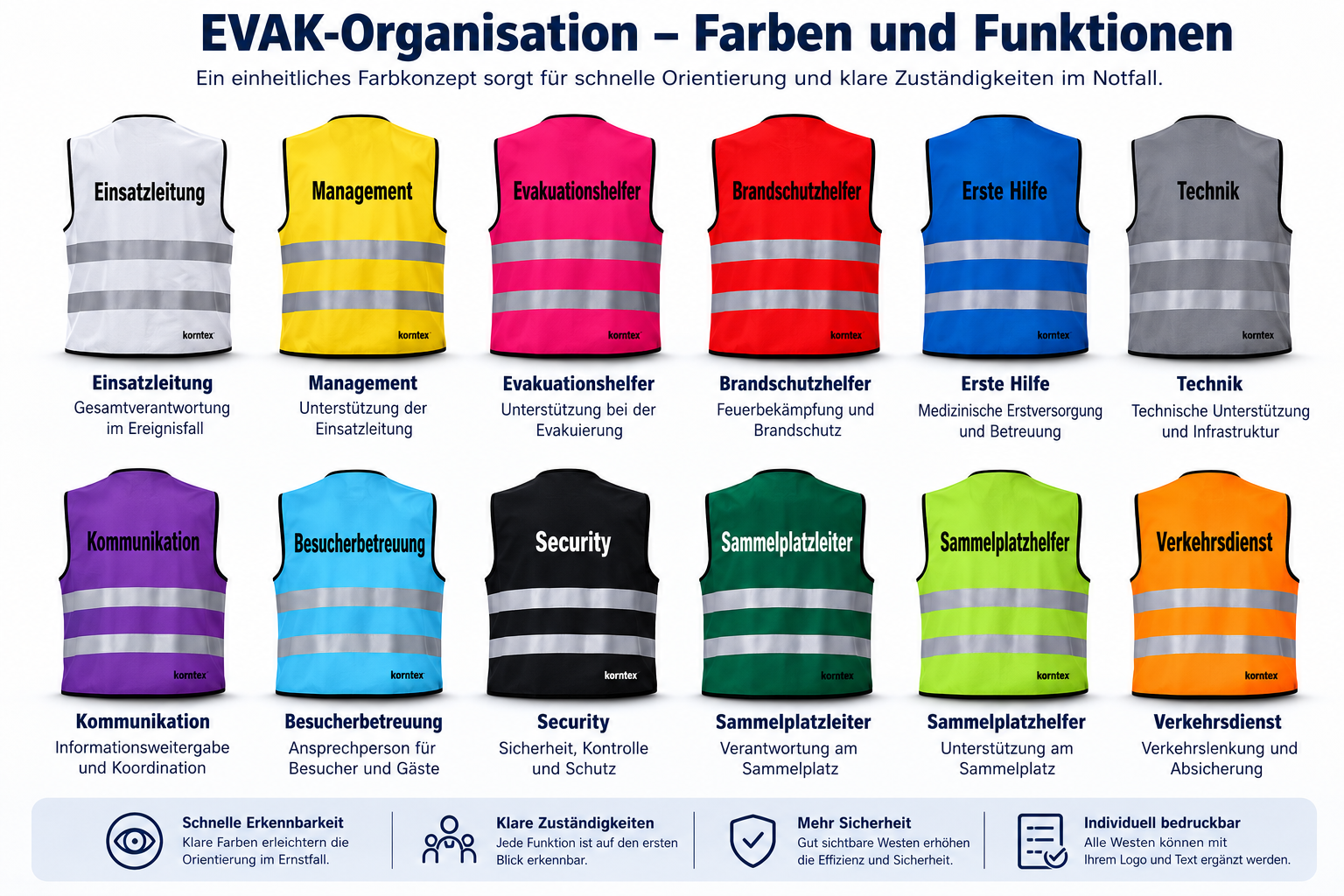
Helme
A safety helmet must be worn whenever there is a risk of head injury—such as from falling objects, swinging loads, bumping into obstacles or other mechanical hazards. Whether helmets are mandatory is determined by the risk assessment, legal occupational safety regulations or company safety rules. Typical areas of use include: Construction sites Industry and manufacturing Logistics and warehousing Trades Energy supply Forestry Rescue and emergency services For professional use, a safety helmet should meet EN 397. In specific work areas additional standards may apply, for example EN 50365 for electrically insulating helmets.
Korntex offers a versatile range of protective helmets for professional use. This includes robust industrial and construction helmets certified to EN 397 that provide reliable protection on construction sites, in industry, trades and logistics. Many models include practical features such as a ratchet size adjuster, chin strap, sweatband, rain gutter and Euro-slot mounts for attaching visors or hearing protection. Helmets come in various colors and, depending on the model, can be personalized with a company logo.
Safety helmets are used wherever employees must be protected from head injuries. They are especially important in sectors with higher accident risk and are a key part of Personal Protective Equipment (PPE). Typical areas of use include: Construction industry Trades Industry Logistics and warehousing Energy supply Road and civil engineering Municipal services Emergency services and fire departments Maintenance and service technicians Depending on the model, Korntex safety helmets meet EN 397 and provide comfortable, reliable head protection for daily work. Many models can be expanded with accessories like visors, hearing protection or chin straps.
For use in industry, construction and trades, helmets typically must meet EN 397. This European standard sets basic safety requirements for industrial safety helmets and ensures protection against common hazards like falling objects, impacts and penetration. Depending on the application, additional standards may be required. For electrical work, helmets meeting EN 50365 protect against electrical voltages. For low-risk tasks involving bumps against fixed objects, bump caps to EN 812 can be used—but they must not replace safety helmets. When buying, check that the safety helmet bears a CE mark and that the applicable standard is permanently marked on the helmet. This ensures the helmet meets required safety standards and is suitable for its intended use.
Yes—many safety helmets can be custom printed. A company logo, department name or personal name creates a professional look and makes it easier to identify personnel on construction sites, in industry or in warehouses. When printing on helmets, only manufacturer‑approved printing methods and areas should be used. Improper modifications can impair helmet material properties. Korntex offers helmets that—depending on the model—can be customized with a company logo or marking.
In principle many helmets can be fitted with stickers. However, only stickers explicitly approved by the helmet manufacturer should be used. Certain adhesives or solvents can attack the helmet material and shorten the protective helmet’s service life. Anyone who wants to permanently mark their helmet should follow the manufacturer’s instructions or have the helmet professionally printed.
Stickers can impair a helmet's protective performance if their adhesives or solvents damage the helmet material. Therefore, only use stickers approved by the manufacturer. Before applying customization, follow the manufacturer's instructions. Alternatively, professional printing is often the safer and more durable option.
Yes—many safety helmets can be printed with a company logo, department label or custom identification. This creates a professional appearance and helps identify staff. To preserve helmet safety, printing should only be done with approved methods. Korntex offers various helmet models that can be customized.
Different printing methods are used for helmets depending on material and design. Pad printing, which works well on curved surfaces, and high‑quality digital printing for multicolor logos are especially common. Which method is suitable depends on the helmet model and the desired design. Professional printing methods ensure durable identification without impairing the helmet’s function.
For construction sites, helmets meeting EN 397 are suitable because they’re specifically designed to protect against falling objects, impacts and other mechanical hazards. A good construction helmet has comfortable size adjustment, a sweatband and fittings for accessories such as hearing protection or visors. This allows the helmet to be adapted to different working conditions.
For electrical work, helmets that in addition to EN 397 meet EN 50365 requirements are suitable. These helmets provide electrical insulation and are designed for certain tasks on low‑voltage installations. The required helmet depends on the specific risk assessment and the employer’s applicable safety rules.
In industry, production and logistics, protective helmets certified to EN 397 are predominantly used. They reliably protect against falling objects, impacts and mechanical stresses. For high wearing comfort, models with a swivel closure, ventilation and sweatband are recommended. Depending on the task, visors or hearing protection can also be attached.
Helmet color is not legally prescribed. Many companies use a color scheme to quickly indicate roles or responsibilities—for example, site managers, electricians, visitors or safety officers may wear different helmet colors. What matters for safety is not the color but that the helmet meets the required standards and is suitable for the intended use.
A safety helmet must fit securely without pressing or slipping. Most industrial helmets have an adjustable headband that can be customized using a dial fit system. Measure your head circumference just above the eyebrows and compare with the manufacturer's sizing. A correctly adjusted helmet increases comfort and ensures full protective performance.
Personal Protective Equipment includes all items that protect employees from health or safety risks. Which PPE is required depends on the task and the risk assessment. PPE includes, among other items: Safety helmets Hi‑vis clothing Safety shoes Protective gloves Safety glasses Hearing protection Respiratory protection Fall protection All components of PPE must comply with applicable European standards, carry a CE mark and be regularly inspected for proper condition.
Arbeitshandschuhe
Work gloves are an important part of personal protective equipment (PPE) and protect hands during various tasks from injuries and external influences. Depending on the design, they protect against mechanical risks such as abrasion, cuts or punctures, as well as cold, heat or certain chemicals. Work gloves are made from materials such as nitrile, latex, polyurethane (PU), leather or textiles and are tailored to different applications. Whether in construction, industry, trade or logistics – the right protective glove increases safety and comfort at work.
Work gloves protect hands from injuries and make safe working easier across many industries. Depending on the model, they can protect against abrasion, cuts, punctures, dirt, moisture or other hazards and can improve grip when handling tools and materials. They are used in construction, trades, industry, logistics, gardening and landscaping as well as assembly work. Choosing the right glove always depends on the task and the risks involved.
Korntex offers a range of work gloves for different applications, including assembly gloves, protective gloves with nitrile or PU coating and other models for industry, trades, logistics and construction. The gloves are characterized by a good fit, high comfort and reliable grip. Depending on the model, they meet relevant European standards and are suitable for professional use as part of personal protective equipment (PPE).
Work gloves are suitable for almost all sectors where hands need protection from mechanical or other job-related hazards. They support safe working and improve comfort during daily tasks. Typical areas of use include: Construction industry Trades Industry Production Logistics and warehousing Gardening and landscaping Assembly Municipal services Maintenance and service Different tasks require different protective gloves with specific properties and certifications.
There are work gloves for a wide range of requirements. Depending on the task, they differ in material, coating and protective function. The most common types include: Assembly gloves Nitrile gloves PU‑coated work gloves Latex gloves Cut‑resistant gloves Cold protection gloves Heat protection gloves Chemical protection gloves Leather gloves Which work glove is appropriate depends on the working conditions and the risk assessment.
The right work glove depends on the task and associated risks. Important factors are the required protection level, material, fit and comfort. Make sure the glove meets the required EN standards and is suitable for the intended use. For work with sharp edges, cut-resistant gloves are recommended, while thin, grippy assembly gloves are better for precise mounting tasks. A well-fitting work glove improves safety and reduces fatigue.
Yes. Work gloves are PPE when intended to protect hands from work-related hazards. They must meet the requirements of EU Regulation 2016/425, carry CE marking and—depending on the application—be tested according to the relevant European standards. Which protective gloves are required is determined by the workplace risk assessment. The employer is responsible for providing suitable PPE and ensuring it is used correctly.
Various European standards apply to work gloves depending on the application and expected risks. The key base standard is EN ISO 21420, which sets general requirements for protective gloves. Additional standards apply depending on the glove’s protective function. Important standards include: EN ISO 21420 — general requirements for protective gloves EN 388 — protection against mechanical risks EN ISO 374 — protection against chemicals and micro‑organisms EN 407 — protection against thermal risks such as heat and fire EN 511 — protection against cold All work gloves sold as Personal Protective Equipment (PPE) must meet the requirements of EU Regulation 2016/425 and bear the CE mark.
EN ISO 21420 is the fundamental standard for protective gloves. It defines general requirements for design, materials, ergonomics, comfort, labeling and manufacturer information. This standard does not assess protective performance against specific hazards. Instead, it provides the basis for other standards like EN 388, EN ISO 374, EN 407 or EN 511, which define particular protective properties of work gloves.
EN 388 is the key standard for work gloves protecting against mechanical hazards. It evaluates resistance to abrasion, cuts, tearing, punctures and—with updated tests—cut resistance according to ISO 13997. Achieved performance levels are indicated on the glove by numbers and letters. The higher a level, the greater the protection against that specific hazard. Gloves to EN 388 are particularly suitable for construction, industry, crafts, logistics and assembly work.
EN ISO 374 applies to protective gloves for chemicals and microorganisms. It defines how well a glove protects against hazardous chemicals, bacteria, fungi or viruses. Depending on model and testing, gloves to EN ISO 374 are suitable for different chemicals and applications. Always verify before use that the glove is approved for the substances you handle.
EN 407 specifies requirements for protective gloves against thermal risks. It evaluates protection against contact heat, convective heat, radiant heat, small metal splashes, and the material's flammability behavior. Gloves certified to EN 407 are used wherever heat or hot materials are handled, for example in metalworking, foundries, and industrial settings.
EN 511 is the European standard for cold-protection gloves. It assesses protection against convective cold, contact cold, and water penetration. Gloves certified to EN 511 are especially suitable for outdoor winter work, cold storage, logistics, or the food industry. They help keep hands warm and functional at low temperatures.
Yes. Work gloves used as personal protective equipment (PPE) must carry CE marking according to EU Regulation 2016/425. CE marking confirms the glove meets relevant European safety and health requirements. The glove or its packaging should also indicate the relevant EN standard, for example EN 388, EN ISO 374, EN 407 or EN 511. This shows which risks the protective glove has been tested and certified for.
The required protection class depends on workplace hazards. There is no single protection class for all work gloves. Gloves are tested against the relevant EN standards and rated for specific risks. For mechanical tasks, for example, work gloves to EN 388 are suitable, while EN ISO 374 applies for chemical work, EN 407 for heat and EN 511 for cold. Choosing the right protective glove should always be based on the risk assessment and the specific working conditions.
Work gloves are made from different materials suited to specific uses. Common materials include nitrile, latex, polyurethane (PU), leather, polyester, nylon and cotton. Many gloves have a coating that improves grip or adds protection against moisture, abrasion or cuts. Which material is best depends on working conditions and the hazards involved. Quality work gloves often combine different materials to balance protection, comfort and dexterity.
Choosing the right work glove depends on the application. Latex gloves offer high elasticity and good grip but are not suitable for people with latex allergies. Nitrile gloves are highly resistant to abrasion, oils and many chemicals and are often used in industry and workshops. PU gloves (polyurethane) impress with excellent tactile sensitivity and are ideal for precise assembly and fine work. Each material has specific advantages. Selection should be based on the requirements of the task.
Work gloves with nitrile or latex coatings provide especially good grip. The textured coating ensures a secure hold—even when handling smooth, oily or wet materials. For assembly work and logistics, PU‑coated work gloves are often the preferred choice because they combine grip, dexterity and fingertip sensitivity.
For work with sharp tools or materials, cut-resistant gloves are suitable. They are made of special high-performance fibers and protect hands from cuts. Cut resistance is tested and marked according to EN 388. Different protection levels are available depending on the risk. The right glove should always be chosen based on a risk assessment.
For work in wet environments, gloves with nitrile, latex or PVC coatings are suitable. These materials protect hands from moisture while providing good grip. Depending on the design, the gloves are either water-repellent or fully waterproof. The choice of model depends on how long they will be in contact with water and the specific working conditions.
For work in cold environments, cold‑protective gloves meeting EN 511 are recommended. They have insulating linings and protect hands from contact and ambient cold. Cold‑protective gloves are often used in construction, logistics, cold stores or outdoor work. They offer a good mix of warmth, comfort and grip.
For construction work, robust work gloves certified to EN 388 are suitable, as they protect against abrasion, cuts, punctures and mechanical stresses. Models with nitrile or latex coatings also provide a secure grip on tools and building materials. Which glove is appropriate depends on the specific task and the results of the risk assessment.
For assembly work, lightweight assembly gloves with PU coating are particularly suitable. They offer excellent tactile sensitivity, high finger mobility and a secure grip when working with small components. Depending on the application, nitrile-coated assembly gloves are also used when additional protection against abrasion or oils is required.
In warehousing and logistics, lightweight work gloves with PU or nitrile coating are predominantly used. They protect against mechanical stresses while allowing secure handling of boxes, tools or goods. The gloves offer high wearing comfort and are suitable for tasks with frequent transitions between gripping, carrying and picking.
For gardening and landscaping, durable work gloves are recommended to protect against dirt, thorns, abrasion and moisture. Depending on the task, nitrile, latex or leather gloves may be used. A good work glove combines protection, grip and comfort so longer tasks can be done safely and comfortably.
For industry and production, gloves to EN 388 are suitable as they reliably protect against mechanical risks. Depending on the task, models with nitrile, PU or latex coatings are used. Selection depends on working conditions and required protective properties, such as cut resistance, grip or chemical resistance.
The correct glove size ensures safety and comfort. Measure the circumference of your hand at the widest point—excluding the thumb—and compare it with the manufacturer's size chart. A well-fitting work glove should be snug without restricting circulation. Too-large gloves reduce dexterity, while too-small ones reduce comfort.
Work gloves should fit snugly while still allowing freedom of movement. Fingers must fully fit into the glove without excess material causing interference or pressure points. A well-fitting work glove improves grip, increases comfort and helps prevent accidents.
Yes, work gloves are available in various sizes and suit both women and men. What matters is not gender but the correct size and a good fit. Many models cover a wide size range and offer high wearing comfort for different hand shapes.
Yes, many work gloves are available in larger sizes in addition to standard sizes, so people with bigger hands can find a suitable protective glove. When choosing, pay attention to the manufacturer’s size chart to ensure optimal fit and full protective effect.
How you clean work gloves depends on the material and manufacturer instructions. Many gloves can be wiped with a damp cloth or mild cleaner, while some models are machine washable. Avoid aggressive detergents and high temperatures, as they can reduce protective performance and damage the material.
Whether work gloves can be washed depends on the material and manufacturer instructions. Many textile and assembly gloves can be washed at low temperatures, while specialist gloves require specific care. Always follow the care instructions to preserve fit, material and protective function as long as possible.
Work gloves should be replaced as soon as they show damage such as tears, holes, heavy wear or a loss of protective effect. Worn coatings or damaged seams can also compromise safety. A regular visual check before use helps detect defects early and ensure protective function.
Store work gloves dry, clean and away from direct sunlight. High temperatures, moisture or aggressive chemicals can damage materials and shorten lifespan. Proper storage helps maintain the protective properties and comfort of gloves over time.
Yes, many work gloves can be customized with a company logo or marking. Different printing methods are available depending on the material and model. Custom printing strengthens a professional corporate image and makes team assignment easier.
Yes. Many work gloves can be personalized with a company logo, lettering or identification. Options depend on the material and available print area. Custom work gloves are particularly suitable for companies, trades and service providers who value a consistent appearance.
Different printing methods are used for work gloves depending on the material. Screen printing, pad printing or special transfer methods are commonly used to apply logos and lettering durably. The appropriate printing method depends on glove type, material and the desired design.
Yes—more and more manufacturers offer sustainable work gloves made from recycled or resource‑saving materials. The aim is to reduce material use and environmental impact without sacrificing protection or comfort. When buying, it's worth checking the declared materials and any sustainability initiatives of the manufacturer.
Are work gloves recyclable? Embroidery is particularly suitable for polo shirts, softshell jackets, fleece jackets, beanies and caps. For warning vests, printing is usually recommended because embroidery can impair the protective function.
Disposal of work gloves depends on their material and use. Clean gloves can usually be disposed of with residual waste. If contaminated with chemicals, oils or other hazardous substances, the rules for special waste must be followed. Follow local disposal guidelines and the manufacturer's instructions to ensure safe and environmentally responsible disposal.
Nitrilhandschuhe
Nitrile gloves are protective gloves made from synthetic nitrile rubber. They provide reliable protection against dirt, moisture, oils, greases and many chemicals, and are particularly tear-resistant and durable. Being latex-free, they are suitable for people with latex allergy. Nitrile gloves are available as single-use or reusable protective gloves and are used across many sectors, including industry, trades, food processing, healthcare and cleaning.
Nitrile gloves protect hands from dirt, moisture, oils, greases, many chemicals and microorganisms while allowing precise work, offering high tear resistance and good tactile feedback. They are used in industry, trades, workshops, the food industry, healthcare, laboratories and cleaning/hygiene tasks. Which nitrile glove is suitable depends on the task and the risks involved.
Korntex offers high‑quality nitrile gloves for professional use in industry, trades, logistics, cleaning and other work areas. Depending on the model, the gloves provide high tear resistance, good comfort and excellent grip. The nitrile gloves are latex‑free and suitable for many applications requiring reliable hand protection. Depending on the version, they meet relevant European standards and can be used as part of personal protective equipment (PPE).
Nitrile gloves are suitable for many sectors where hands need protection from dirt, moisture, oils, chemicals or other hazards. Typical areas of use include: Industry Trades Workshops Logistics and warehousing Food industry Cleaning and facilities management Healthcare Laboratories Municipal services Thanks to their high durability and good tactile feel, nitrile gloves are versatile and suitable for many professional applications.
Nitrile gloves offer many advantages over other glove materials. They are particularly tear-resistant, latex-free and show high resistance to many oils, greases and chemicals. Key advantages include: high tear and abrasion resistance latex-free and allergy-friendly good chemical resistance high grip good tactile sensitivity comfortable to wear versatile in use These properties make nitrile gloves an ideal choice for industry, trades, food processing, cleaning and many other fields.
Choosing the right glove material depends on the intended use. Nitrile gloves are tear-resistant, latex-free and resistant to many oils, greases and chemicals. They are suitable for demanding tasks in industry, trades or laboratories. Latex gloves are highly elastic and provide excellent tactile sensitivity, but they are not suitable for people with a latex allergy. Vinyl gloves are an economical option for light tasks with low mechanical or chemical exposure. They generally offer less elasticity and durability than nitrile or latex gloves.
Yes. Nitrile gloves are PPE when used to protect against work-related risks. They must comply with EU Regulation 2016/425, carry CE marking and—depending on the area of use—be tested to relevant European standards such as EN ISO 21420 or EN ISO 374. Which nitrile gloves are required depends on the task and the workplace risk assessment. The employer must provide appropriate protective gloves and ensure they are used correctly.
Different European standards apply to nitrile gloves depending on the intended use. The fundamental standard is EN ISO 21420, which sets general requirements for protective gloves. Additional standards apply depending on the protective function. Important standards include: EN ISO 21420 — general requirements for protective gloves EN ISO 374 — protection against chemicals and micro‑organisms EN 455 — medical single‑use gloves Regulation (EC) No 1935/2004 — materials intended to come into contact with food (for food‑safe gloves) All nitrile gloves used as Personal Protective Equipment (PPE) must meet the requirements of EU Regulation 2016/425 and carry the CE mark.
EN ISO 21420 is the basic standard for protective gloves. It sets general requirements for ergonomics, comfort, materials, labeling and manufacturer information. The standard does not evaluate specific protective properties. These are defined by additional standards such as EN ISO 374 for chemical protection or EN 388 for mechanical risks.
EN ISO 374 describes requirements for protective gloves against chemicals and microorganisms. It tests how well a glove protects against hazardous chemicals and against bacteria, fungi and—depending on certification—viruses. Nitrile gloves meeting EN ISO 374 are suitable for many applications in labs, industry, cleaning or healthcare. Before use, check whether the glove is approved for the specific chemicals involved.
EN 455 is the European standard for medical disposable gloves. It specifies requirements for impermeability, physical properties, biological safety and glove durability. Nitrile gloves certified to EN 455 are used especially in healthcare, medical practices, care facilities and laboratories.
Many nitrile gloves are suitable for contact with food. They must comply with applicable regulations for food-contact materials and be explicitly labeled as food-safe by the manufacturer. Food-safe nitrile gloves are used, among other places, in food production, gastronomy and food processing.
Yes. Nitrile gloves used as personal protective equipment (PPE) must be CE marked in accordance with EU Regulation 2016/425. This confirms the glove meets applicable European safety requirements. The relevant EN standards should also be indicated on the product or packaging so the intended protective performance is clearly identifiable.
The appropriate protection class depends on the task and the hazards involved. For chemical work, nitrile gloves to EN ISO 374 are suitable; in medical settings, EN 455 is often additionally required. Choosing the right nitrile glove should always be based on a risk assessment and the intended application.
Yes. Most modern nitrile gloves are powder-free, which reduces the risk of skin irritation and minimizes contamination risk in sensitive work areas. Powder-free nitrile gloves are preferred in food production, healthcare, laboratories and industrial settings.
Yes. Nitrile gloves are made from synthetic nitrile rubber and are completely latex-free. This makes them particularly suitable for people with latex allergies or sensitivities. Despite being latex-free, nitrile gloves offer high elasticity, comfortable wear and excellent tear resistance.
Yes, nitrile gloves are characterized by high tear and abrasion resistance. Compared with many vinyl gloves, they are significantly more robust and therefore suitable for demanding tasks. The high durability makes nitrile gloves an ideal choice for industry, workshops, cleaning and many other professional applications.
Yes, nitrile gloves provide very good resistance to many chemicals, oils and solvents. Actual protection depends on the specific chemical, its concentration and exposure time. For work with hazardous substances, only nitrile gloves tested to EN ISO 374 should be used.
Yes—nitrile gloves are highly resistant to many oils, fats and lubricants. That’s why they’re often used in workshops, industry, mechanical engineering and food processing. Their good resistance and grip also provide a high level of safety under oily working conditions.
Yes. Nitrile gloves come in different colors; at Korntex they are available in blue and black. Color is often used to distinguish work areas or comply with company standards. Color choice usually does not affect protective performance. What matters are the applicable standards and product properties.
Nitrile gloves come in different sizes—typically S to XL or larger. The right size ensures optimal comfort, tactile sensitivity and secure handling. A glove should fit snugly without constricting. Gloves that are too large impair dexterity, while too-small gloves can tear more easily.
For industrial use, nitrile gloves with high tear resistance and good resistance to oils, fats and mechanical stress are suitable. Depending on the area of application, they should meet the relevant standards such as EN ISO 21420 or EN ISO 374. Choosing the right glove depends on the specific working conditions and the risk assessment.
In workshops nitrile gloves are mainly used because they resist oils, greases and lubricants while still providing good tactile sensitivity and a secure grip during repair and maintenance work. Robust nitrile gloves are particularly suitable for work on vehicles, machines and metal.
For the food industry, food-safe nitrile gloves are suitable; they are approved for contact with food, hygienic, latex-free and often powder-free. They are used, among other areas, in food production, processing, gastronomy and large kitchens.
For cleaning and hygiene tasks, nitrile gloves are suitable; they protect against moisture, cleaning agents and many chemicals. Models conforming to EN ISO 374 offer additional protection when working with chemical cleaners. They are used, among other places, in building cleaning, healthcare and facility management.
For medical applications, nitrile gloves conforming to EN 455 are suitable. They meet the requirements for medical disposable gloves and provide high hygiene and reliable protection. Latex-free nitrile gloves are especially popular because they reduce the risk of latex allergy while offering high wearing comfort.
Most nitrile gloves are designed as disposable gloves and should be discarded after use. For certain industrial applications there are reusable nitrile gloves with thicker material. Whether a glove may be reused depends on the manufacturer's instructions and the application.
The wear time of nitrile gloves depends on the activity, stress and substances used. Disposable gloves should be changed as soon as they are soiled, damaged or no longer hygienic after extended use. When working with chemicals, you should also observe the breakthrough time specified by the manufacturer.
Nitrile gloves should be changed immediately if they are damaged, torn or heavily soiled. They should also be replaced after contact with certain chemicals or when moving between different work areas. Regular changes contribute to workplace safety and hygiene.
Store nitrile gloves in a dry, cool place away from direct sunlight. High temperatures, UV light and humidity can degrade the material and shorten shelf life. Gloves should be kept in their original packaging until use.
Whether nitrile gloves are recyclable depends on the material and how they were used. Disposable nitrile gloves are generally not recycled after use, especially if contaminated. Disposal should always follow applicable regulations and the manufacturer’s instructions.
Disposal of nitrile gloves depends on their use. Clean gloves can usually go in the residual waste. If contaminated with chemicals, hazardous substances or infectious material, the appropriate disposal rules must be observed. Always follow regional regulations and the manufacturer's guidance.
Warnwesten für Tiere
No—hi‑vis vests for animals are not legally required in Switzerland or most other countries. However, they significantly increase the visibility of dogs and other animals and help prevent accidents. Hi‑vis vests for dogs are particularly useful for walks at dusk or night, in traffic, during hunts and in search‑and‑rescue operations.
Yes, many hi‑vis vests for animals can be custom printed. Depending on the model, names, logos, club names or labels like “Rescue Dog,” “Search Dog,” “Therapy Dog” or “Please do not pet” can be added. Custom printing improves recognizability and creates a professional appearance for clubs, rescue organizations or dog schools.
Yes, many hi‑vis vests for dogs and other animals can be personalized with the animal’s name. Phone numbers, logos or custom text are also possible. A personalized hi‑vis vest makes identification easier and is suitable for private use as well as for rescue, therapy or service dogs.
Yes, vests for animals are excellent for rescue, search, therapy and service dogs. Bright colors and custom prints make the dogs immediately identifiable during operations. Depending on the area of operation, vests can be branded with role labels, logos or organization names to ensure clear identification on site.
Yes, many hi‑vis vests for animals can be printed with company logos, club names, organizations or custom text. This makes them ideal for dog schools, rescue organizations, dog sport clubs or response teams. Professional printing creates a consistent appearance and improves recognition.
Yes. Hi‑vis vests for animals significantly increase visibility. Bright signal colors and reflective strips help dogs and other animals be noticed earlier in poor light or traffic. Good visibility helps reduce accident risk and increases safety during walks, training or work operations.
For an animal hi‑vis vest, neon yellow and neon orange work particularly well because they are highly visible by day. Combined with reflective strips, visibility is further improved. Color choice depends on the application. For hunting, rescue or search dogs, bright signal colors are often used so the animals remain clearly visible.
Yes. Reflective stripes are an essential component of a high-quality warning vest for animals. They reflect the light of vehicle headlights or torches and greatly improve visibility at night and in low light. Combined with a bright signal color, reflective strips provide the best possible protection in everyday life and during work operations.
Yes—hi‑vis vests for animals are specifically designed to boost visibility at dusk, night and in poor weather. Bright colors and reflective stripes help dogs and other animals be seen earlier. For walks along roads or in low‑visibility terrain, safety vests provide an extra safety benefit.
A hi‑vis vest for animals does not directly prevent accidents but significantly increases visibility. This lets drivers, cyclists and other road users spot dogs and other animals earlier and react in time. Hi‑vis vests are therefore a sensible addition for increased safety on roads, especially in darkness and poor visibility.
Yes. Warning vests for animals are excellent for hunting, search and rescue dogs. The bright colors make animals easier to locate in the terrain and also increase their visibility to others. Depending on the use, these vests can also be printed with functional labels or logos.
A hi‑vis pet vest is a lightweight safety vest with bright signal colors and reflective strips. It’s designed to increase the visibility of dogs and other animals in low light or traffic. Pet hi‑vis vests are commonly used for walks, dog sports, rescue missions, hunting or training and improve recognizability.
Hi‑vis vests for animals help make dogs and other animals more visible. They increase safety on walks, in traffic, during rescue missions, in canine sports or during hunting. Their bright colors and reflective strips help spot animals earlier and reduce accident risk.
Korntex offers animal warning vests designed specifically to increase the visibility of dogs and other animals. These models feature bright signal colors and reflective stripes for good visibility day and night. Depending on the model, the warning vests can be customized with names, logos or job titles and are suitable for private use as well as for rescue organizations, dog trainers or clubs. We also offer a warning vest specifically for chickens.
A hi‑vis vest for dogs increases visibility and helps the dog be seen earlier in darkness, fog or poor weather. This can significantly reduce the risk of accidents in traffic or rough terrain. A hi‑vis vest is also suitable for identifying rescue, search, therapy or service dogs, as well as dogs in training.
A hi‑vis vest for animals is useful whenever visibility needs to be improved. That includes walks at dusk or night, outings in fog or rain, time spent near roads, and deployments of rescue, search or hunting dogs. Bright colors and reflective strips help animals be noticed sooner, increasing their safety in everyday situations and professional operations.
Einweg Regenponcho
A disposable rain poncho is a lightweight, compact rain cover that can quickly be pulled on over clothing when it starts to rain. It’s made of thin, water‑resistant plastic and protects the torso and much of the legs from wetness. Because they’re lightweight and pack down small, disposable rain ponchos are ideal for events, outdoor activities, travel, emergencies or as a spare in a car or backpack.
A disposable rain poncho reliably protects against rain and moisture when bad weather appears unexpectedly. It can be put on in seconds and provides a practical solution on the go. Disposable rain ponchos are often used at festivals, sports events, concerts, hikes, corporate events, street fairs and outdoor activities. They also make a sensible addition to car or backpack emergency kits.
Korntex offers practical disposable rain ponchos that are lightweight, compact and provide reliable rain protection. They’re suitable for events, promotions, outdoor activities and private or commercial use. Depending on the model, disposable rain ponchos are available in various colors and can be customized with a company logo or promotional print.
Disposable rain ponchos are for anyone who wants quick, convenient rain protection on the go. They’re ideal for event visitors, hikers, cyclists, travellers and staff on outdoor assignments. Companies, clubs, event organisers and organisations also use disposable rain ponchos as practical equipment or promotional items.
A disposable rain poncho convinces with easy handling and practical utility. It is light, compact and can be stored space‑saving in bags, backpacks or vehicles. Key advantages include: quick protection from rain low weight small pack size easy to put on One size fits many people ideal for events and emergencies also suitable as a promotional item
A disposable rain poncho makes sense when short-term rain protection is needed. It is ideal for outdoor events, festivals, sports, hikes, travel or as emergency gear. Its compact format means the poncho can be carried at all times and used immediately when needed.
Most disposable rain ponchos are made from lightweight PE (polyethylene) or a similar water-resistant plastic. The material is flexible, tear-resistant, and reliably protects against rain. Because of their low material weight, the ponchos fold down very small and can be packaged space-efficiently.
Yes, disposable rain ponchos are waterproof and provide reliable protection from rain. They prevent clothing from getting soaked during short to moderate showers. For longer deployments or extreme weather conditions, however, high-quality rainwear made from more robust materials is recommended.
Disposable rain ponchos offer some protection against wind and will block light to moderate wind. Because they’re made of thin material and worn loosely, they’re not comparable to specialized weatherproof clothing. They’re mainly suitable as short‑term protection in changeable weather.
Yes, most disposable rain ponchos have an integrated hood that gives extra protection for head and hair. The generous fit lets the poncho be pulled quickly over clothing to provide comprehensive weather protection.
Yes—disposable rain ponchos are usually offered in one size. Their generous cut allows wearing them over regular clothing or a light jacket. That makes the ponchos suitable for most adults and particularly practical for events or emergency kits.
Depending on the model, disposable rain ponchos come in various colours. Popular choices include transparent, blue, yellow, red, green, orange and black. For promotions and events, colours can be matched to corporate identity or the event concept.
A disposable rain poncho can be folded to a very small pack size and easily fits in a handbag, backpack, glove compartment or jacket pocket. Its compact format makes it an ideal companion for travel, events or emergencies.
Disposable rain ponchos are suitable for almost any outdoor event. They give visitors and staff quick protection against unexpected rain. Typical uses are festivals, concerts, sporting events, corporate events, city festivals, open‑air cinemas, markets and club events.
Yes, disposable rain ponchos are standard gear for many festival-goers. They protect reliably from rain, are easy to carry and can be put on quickly. Many organizers also hand out disposable rain ponchos as a service or promotional item.
Yes. Disposable rain ponchos are ideal for outdoor sporting events. Spectators stay dry in the rain without needing a bulky rain jacket. They are commonly used at football matches, running events, bike races or open-air sports events.
Yes, disposable rain ponchos are ideal for hikes, camping, bike tours, day trips and other outdoor activities. They offer quick rain protection and can be compactly stored or disposed of after use. Their low weight makes them a practical companion on the go.
Yes, disposable rain ponchos are excellent as part of an emergency kit. They fit in any car, backpack or first-aid kit and are ready for sudden rain. They are especially handy while traveling or during outdoor activities, providing simple and reliable weather protection.
Yes—disposable rain ponchos are popular promotional items for companies, clubs and organisers. They combine high practical value with a large advertising area and recipients often use them immediately. Custom printed rain ponchos are particularly effective as advertising at festivals, sports events, promotions and corporate events.
Yes—many disposable rain ponchos can be printed. Logos, slogans or promotional messages can be placed on the front or back depending on the model. Printed disposable rain ponchos are excellent for promotions, events, clubs or companies.
Yes. Single-use rain ponchos can be custom-printed with a company logo, lettering or promotional design, creating a practical promotional item with high visibility. Custom-printed disposable rain ponchos are often used at events, trade shows, festivals and corporate events.
For disposable rain ponchos, different printing methods are used depending on material and design. Screen printing and special transfer methods are commonly used to achieve durable prints even on thin plastics. The right printing method depends on the poncho model, print area and desired design.
Yes, disposable rain ponchos are often used for promotional and marketing campaigns, sports events, festivals, concerts or corporate events. They can be customized and offer a large advertising area for logos or messages. Because of their usefulness and high visibility, disposable rain ponchos are a popular promotional item and a helpful service for visitors.
Beanie
A beanie is a close‑fitting knitted hat that keeps the head comfortably warm and offers a modern look. Unlike traditional winter hats, beanies usually have no brim and may be worn with or without a cuff depending on the model. Beanies are suitable for everyday wear, work, outdoor activities, sports and as part of work or team clothing. With a wide range of colours and materials they are very versatile.
Beanies primarily keep the head warm in cold conditions. They are also a popular fashion accessory and commonly used as part of work or club apparel. They’re used in trades, logistics, outdoor work, sports, events and leisure activities.
Korntex offers high-quality beanies known for comfortable wear, good insulation and modern design. The hats are suitable for work, leisure, clubs and promotions. Depending on the model, beanies come in various colors and can be personalized with a logo or embroidery.
Beanies are suitable for women, men and youths and are versatile. They are worn privately as well as at work. Beanies are especially popular with employees in trades, logistics, construction, outdoor work, clubs and in sports and leisure.
A beanie combines comfort, function and modern styling. It keeps the head pleasantly warm, fits comfortably and is easy to pair with different outfits. Key advantages include: comfortable to wear good protection against the cold lightweight and space-saving versatile in use suitable for work and leisure can be custom embroidered or printed
A beanie is especially useful in cool and cold temperatures. It protects the head from wind and cold while providing comfortable wear. Whether for day-to-day work, outdoor activities, sports or leisure, beanies are a great choice whenever extra warmth is needed.
Most beanies are made from soft, durable materials such as acrylic, polyester, cotton, or blends. Some models also use recycled fibers. The materials used provide comfortable wear, good thermal insulation, and long service life.
Yes—beanies provide reliable protection from cold and help retain body heat through the head. Depending on material and thickness, they suit different temperature ranges. Knitted beanies are especially suitable for autumn, winter and cool spring days.
Yes. Many beanies are made from breathable materials that wick moisture away and provide a comfortable wearing experience. Depending on the material, beanies are suitable for everyday wear as well as for physically demanding tasks or sports activities.
Yes. Beanies are excellent for winter. They keep the head comfortably warm and protect against wind and low temperatures. Depending on material and construction they offer light to very good cold protection and are suitable for everyday use as well as outdoor work.
Yes—many beanies come with a cuff. This provides extra warmth at the forehead and ears and also offers an ideal surface for logos or embroidery. Cuffed beanies are especially popular for workwear, club hats or promotional items.
Yes—beanies are available in many colors, from classic shades like black, gray or navy to striking hues such as red, yellow, green or orange. This allows the hats to be matched perfectly to a company’s corporate design or to club colors.
Yes—many beanies come in one size. Thanks to elastic materials, they adapt comfortably to different head circumferences and provide a secure fit. That makes them suitable for most adults.
Most beanies are stretchable and offered in one size. They adapt to head shape and provide a comfortable fit without pinching. If multiple sizes are offered, check the manufacturer's size chart.
Beanies suit many industries where employees work in cool temperatures, such as construction, trades, logistics, warehousing, gardening, facility management, transport and outdoor services. They complement workwear and provide added comfort in cold seasons.
Yes, beanies are excellent for construction sites and trades—especially for outdoor work or unheated areas. They keep the head warm and provide comfortable wear. Depending on the job, occupational safety rules must be followed. Where a safety helmet is required, a beanie does not replace personal protective equipment.
Yes. Beanies are ideal for outdoor work. They protect the head from cold and wind and provide comfortable wear even during extended outdoor tasks. They are commonly used in construction, logistics, gardening and municipal work.
Yes, beanies are suitable for many sports such as running, hiking, cycling, and winter sports. They keep the head warm while offering a comfortable fit. Breathable materials ensure excess moisture is transported to the outside.
Yes, beanies are a practical addition to workwear. They keep employees warm in cold conditions and can support a uniform company appearance. Many companies have beanies personalized with their logo and equip their teams with them.
Yes. Beanies are ideal for clubs, sports teams, events and promotions. They create a unified look while offering practical benefits. Custom beanies are also popular as fan items and team accessories.
Yes—many beanies can be customized. Depending on the material and model, printing with logos, lettering or promotional motifs is possible. Printed beanies are ideal for companies, clubs, promotions or events and create a professional appearance.
Yes—beanies are excellent for embroidery. High‑quality embroidery is durable and gives the cap a refined look. Embroidered beanies are a popular choice for corporate apparel, clubs, sports teams and promotional items.
Yes. Many beanies can be personalized with a company logo, club emblem or custom text. Depending on the model, personalization is done by embroidery or print. Personalized beanies strengthen brand presence and are ideal as workwear, teamwear or promotional items.
Different finishing techniques suit beanies depending on the material. Embroidery is especially popular because it looks high-quality and is durable. Depending on the model, printing methods or sewn-on patches are also possible. The choice of method depends on the material, the design and the desired look.
Yes, beanies are popular promotional items because they combine high utility with a large branding area. With a company logo or slogan they provide long-term brand visibility. They are especially suitable for companies, clubs, promotions, events, customer gifts and staff equipment.
Beanie, knitted hat and cuffed beanie refer to different hat styles that mainly differ in shape and how they are worn. A beanie is a modern, close-fitting hat usually worn without a cuff. It sits snugly or slightly slouched at the back of the head and is popular for everyday wear and work. A knitted hat is a general term for hats made by knitting. It comes in many versions — with or without cuff, tight or loose — and offers reliable cold protection. A cuffed beanie has a folded brim that adds extra warmth to the forehead and ears. The cuff also creates a larger area ideal for embroidery or a company logo. All three hat types keep the head warm and are suitable for leisure, outdoor activities and workwear. The right style depends on comfort, use and personal preference.
Thinsulate 3M
3M Thinsulate is a premium insulation material designed to keep you warm in cold conditions. The fine microfibres efficiently retain body heat, providing strong thermal performance with minimal bulk. Thanks to its lightweight, compact properties, 3M Thinsulate is commonly used in winter hats, gloves, jackets and other cold-weather gear. It offers good comfort and suits both professional work and leisure or outdoor activities.
3M Thinsulate consists of very fine microfibres that trap air between the fibres. This trapped air acts as an insulating layer, helping retain body heat while reducing cold from outside. Because of its fine fibre structure, 3M Thinsulate provides high thermal insulation without making garments bulky or heavy. That delivers comfortable wear and good freedom of movement.
3M Thinsulate combines high thermal insulation with low weight and slim material thickness, resulting in warm yet comfortable products for everyday use. Key advantages include: high thermal insulation low weight comfortable to wear good breathability slim and flexible construction suitable for work, leisure and outdoor activities
Korntex offers selected beanies and other winter accessories with 3M Thinsulate insulation. They combine effective warmth with high comfort and are ideal for outdoor work and cold-weather leisure activities. Depending on the model, products are available in different colors and can sometimes be customized.
Products with 3M Thinsulate are ideal for anyone who wants to stay warm and comfortable in cold conditions. They’re used both at work and for leisure. They’re especially suitable for workers in construction, logistics, horticulture and transport, as well as for outdoor athletes and anyone who spends a lot of time outdoors.
Yes. 3M Thinsulate delivers high thermal insulation and was specifically developed for cold conditions. Its fine microfibers retain body heat efficiently and ensure comfortable wear. At the same time, the material remains lightweight and low-profile, preserving freedom of movement and comfort.
Yes—3M Thinsulate is breathable. The material supports moisture transport and helps excess heat and humidity escape. This keeps the wearing comfort pleasant even during long shifts or physical activity.
Yes—3M Thinsulate is known for its low weight. Despite high insulation performance, the material remains pleasantly light and adds little bulk. That’s what makes 3M Thinsulate comfortable and ensures high freedom of movement.
3M Thinsulate itself is an insulating material and helps maintain warmth even in damp conditions. How well a product protects against rain or moisture mainly depends on the outer material used. For work in bad weather we therefore recommend garments with a water-repellent or waterproof outer layer.
Yes, 3M Thinsulate was specifically developed for cold conditions. The material provides reliable thermal insulation and is suitable for outdoor work, winter sports and many other cold-weather activities. The lightweight design maintains comfort even during extended wear.
Compared with conventional padding, 3M Thinsulate uses much finer microfibers that provide efficient insulation with less bulk. This results in lighter, less bulky products with high comfort. The combination of low weight, flexibility and good thermal performance makes 3M Thinsulate a popular insulation for winter clothing.
Products with 3M Thinsulate are suitable for many industries where work is carried out in low temperatures. These include, among others, construction, logistics, transport, horticulture, municipal services as well as warehouse and field service work. They provide additional thermal comfort and help make outdoor work more comfortable.
Yes. 3M Thinsulate is excellent for outdoor work. Its insulation helps retain body heat and provides high comfort even in cool temperatures. That is why the material is often used in winter clothing for construction, logistics, landscaping and many other outdoor professions.
Yes. 3M Thinsulate is commonly used in winter sports clothing and accessories. It provides high thermal insulation at low weight and supports comfortable wear during active sports. It is suitable, among other activities, for skiing, snowboarding, winter hiking and other outdoor pursuits.
Yes, products with 3M Thinsulate are great for everyday use. They keep you comfortably warm in cold temperatures while offering good wearing comfort. Whether on the commute, a walk or at work—the lightweight insulation makes winter accessories with 3M Thinsulate practical companions.
Products with 3M Thinsulate should be cleaned according to the manufacturer's care instructions. Recommended wash temperatures and care methods vary by product and outer material. With proper care, comfort and insulation performance are preserved over time.
Yes, many products with 3M Thinsulate can be washed. Always follow the care instructions on the label, as they vary by material and construction. Gentle cleaning helps preserve insulation quality and function over time.
With correct care and normal use, 3M Thinsulate retains its insulating performance for a long time provided the manufacturer's care instructions are followed and the products are not subjected to undue stress. Regular gentle care helps maintain warmth and prolong the life of clothing and accessories.
Cap
A cap is a head covering with a fixed brim that shields the face and eyes from the sun. It’s worn in everyday life, at work, during sports or at events, combining function with a contemporary look. Caps come in various styles, colors and materials and can often be customized with a company logo or text.
Caps shield the head and face from sun and glare. They’re also a popular fashion accessory and part of corporate, club and team apparel. They’re used in trades, logistics, landscaping, outdoor work, sports, promotions and events.
Korntex offers high-quality caps suitable for work, leisure, sports and promotions. The models provide comfortable wear, robust construction and a wide range of colors. Many caps can be customized with a company logo, club name or promotional design and are ideal as workwear or promotional items.
Caps are suitable for women, men and youths and are versatile. They are worn both privately and at work. Caps are especially popular with employees in trades, logistics, gardening, outdoor services as well as with clubs, sports teams and companies.
A cap offers effective sun protection while remaining very comfortable. Thanks to its brim, it shields the face and eyes from direct sunlight. Key advantages include: Protection from sun and glare comfortable to wear lightweight and breathable versatile in use can be custom printed or embroidered ideal for work, leisure and promotions
A cap is especially useful on sunny days because it protects the head and face from direct sunlight. It's also suitable for outdoor work, sports, leisure activities, and events. Caps are also often worn as part of a unified work or team outfit.
In everyday usage the terms cap and baseball cap are often used interchangeably. A cap is the general term for brimmed hats, while the baseball cap is a specific form of cap. Typical for a baseball cap are the curved brim, multiple fabric panels and an adjustable closure at the back. Today it’s worn well beyond baseball and is one of the most popular headwear choices for work, leisure and sport.
Caps are suitable for many industries, especially where staff work outdoors or a uniform appearance is desired. Typical uses include construction, logistics, landscaping, transport, event management, hospitality, promotions, and leisure or sports clubs.
Yes, caps are a popular complement to workwear. They protect from sunlight and help create a professional look. Many companies have caps personalized with their logo and issue them to employees.
Yes. Caps are well suited for outdoor work. The brim shields the face and eyes from direct sunlight and increases comfort during outdoor tasks. They are often worn in horticulture, on construction sites, in logistics or for municipal services. Where a safety helmet is required, a cap does not replace personal protective equipment.
Can caps be worn during sports? Caps are worn for running, golf, tennis, hiking, cycling and many other outdoor sports.
Yes, caps are ideal for clubs, sports teams, corporate events and functions. They create a unified look and increase group recognition. With individual embroidery or printing, caps become practical team accessories or fan items.
Yes—caps are among the most popular promotional items for campaigns and marketing. They offer a visible advertising surface and are often used by wearers for a long time. That’s why custom‑branded caps achieve wide reach and lasting brand presence.
Yes—many caps can be customized. Logos, lettering or promotional designs can be applied to various parts of the cap depending on the model. Printed caps are great for companies, clubs, promotions and events.
Yes—caps take embroidery well. Embroidery is long‑lasting, high quality and resists daily wear. Embroidered caps are a popular option for corporate apparel, clubs, sports teams and promotional merchandise.
Yes. Many caps can be personalized with a company logo, club emblem or custom text. Depending on the model, finishing is by embroidery or print. Personalized caps are ideal as workwear, teamwear, promotional items or giveaways for events.
Various finishing options are available for caps. Embroidery is particularly popular because it is durable and gives a premium look. Depending on the model, printing techniques or sewn-on patches can also be suitable. The choice of the right method depends on the material, the design and the desired appearance.
Yes, caps are popular promotional items because they combine high utility with a large branding area. With a company logo or slogan they ensure long‑term brand visibility. They are suitable for companies, clubs, trade shows, promotions, sports events and many other occasions.
Yes, caps protect the head and face from direct sunlight. The brim reduces glare and helps shield the eyes and face from UV rays. For longer periods outdoors, it is advisable to combine the cap with sun protection measures such as sunscreen and suitable clothing.
Yes—many caps are made from breathable materials like cotton, polyester or blends. Ventilation eyelets or mesh panels further promote airflow for comfortable wear. That’s why caps are also suitable for physically demanding tasks, sports and warm summer days.
All three forms occur in German, but their usage differs in prevalence:
Pilotenjacke
The pilot jacket is also known as a flight jacket or, depending on the model, a bomber jacket. Originally developed for pilots, it is characterized by its comfort and insulating properties. In workwear, the term pilot jacket usually refers to a functional work jacket with warm lining, several pockets and often detachable sleeves or a removable inner lining, allowing flexible use as a winter or transitional jacket.
A pilot jacket is a robust, warm jacket originally developed for pilots. Today it’s used as work and leisure outerwear and stands out for its high functionality. Typical features of a pilot jacket include a warm lining, a full-length zipper, multiple practical pockets and—depending on the model—a removable lining or detachable sleeves. This makes it suitable for changing weather and diverse uses.
The pilot jacket gets its name from its original use in aviation. As early as the early 20th century, pilots wore specially designed jackets to protect them from wind and cold in unheated cockpits. These flight jackets evolved into today's pilot jacket. Modern models retain the functional core concept and are now mainly worn as work jackets and for leisure.
A pilot jacket is defined by its combination of warmth, functionality and durability. It was developed for use in cool temperatures and offers high wearing comfort. Typical features include: warm inner lining wind‑resistant outer material multiple practical pockets comfortable fit often removable sleeves or a removable inner lining versatile as a winter or transitional jacket These features make pilot jackets especially popular in construction, logistics, transport and many outdoor occupations.
The term pilot jacket refers to a functional jacket that originated from pilots’ clothing. It was designed to reliably protect against cold and wind. Today the pilot jacket mainly denotes a sturdy work or casual jacket with good insulation, practical pockets and high wearing comfort. Some models also feature a removable lining or detachable sleeves.
Yes. Many pilot jackets are designed as winter jackets. Thanks to their warm lining they offer good protection in low temperatures and are especially suitable for outdoor work or daily use in cold seasons. Models with removable inner linings or detachable sleeves can often be worn as transitional jackets and are therefore particularly versatile.
Common synonyms for a pilot jacket are flight jacket and—depending on the cut—bomber jacket. In workwear contexts terms like work pilot jacket or winter work jacket are also used. While classic flight and bomber jackets are often fashion-oriented, pilot jackets for professional use prioritize functionality, warmth and durability.
A pilot jacket should always be washed according to the manufacturer's care instructions. In many cases, a gentle machine wash at low temperature is possible. Before washing, empty pockets and remove any removable lining or sleeves if present. Avoid fabric softeners and high tumble-dry temperatures, as they can damage the materials and functional properties. Proper care preserves the comfort, fit, and protective function of the pilot jacket over time.
A pilot jacket combines warmth, functionality and durability in one garment. It reliably protects against cold and wind and is suitable for daily work and outdoor use. Key advantages include: good thermal insulation high wearing comfort robust and long‑lasting materials numerous practical pockets often available with removable inner lining or detachable sleeves versatile as a winter or transitional jacket Thanks to its functional features, the pilot jacket is a popular choice for trades, construction, logistics and many other sectors.
A bomber/pilot jacket is especially suitable in cool and cold weather. It provides reliable protection from wind and weather and keeps you comfortable during longer periods outdoors. It’s often worn in construction, logistics, transport, municipal work and other outdoor tasks. Models with removable liners are also suitable for transitional seasons.
Yes, pilot jackets come in various colors. Besides classic shades like black, navy or gray, there are models in high-visibility yellow and orange for tasks requiring increased visibility. The appropriate color depends on the area of use, company guidelines and any high-visibility requirements.
Pilot jackets come in various sizes to ensure a comfortable fit and sufficient freedom of movement. The right size depends on body measurements and desired comfort. If the jacket will be worn over other work clothing or multiple layers, factor that into your size choice. A manufacturer size chart helps find the correct size.
Not every pilot jacket meets EN ISO 20471. That standard applies only to hi‑vis garments that ensure increased visibility day and night. Specially designed hi‑vis pilot jackets with fluorescent materials and reflective strips can be certified to EN ISO 20471. Whether a jacket meets the standard and its protection class is stated in the product information.
Yes. Korntex offers high-visibility pilot jackets designed specifically for tasks requiring increased visibility. They combine the insulating properties of a pilot jacket with fluorescent materials and reflective stripes. Depending on the model, high-visibility pilot jackets meet EN ISO 20471 requirements and are suitable for roadworks, construction sites, logistics or municipal services.
Pilot jackets are suitable for many sectors that work in cool or changeable conditions. They provide warmth, comfort and high durability. Typical areas of use include: Construction industry Trades Logistics and warehousing Transport and freight Gardening and landscaping Municipal services Industry and facility management For work areas requiring increased visibility, hi‑vis pilot jackets are available.
Yes, pilot jackets are excellent for construction sites. They provide warmth in cold conditions and are robust enough for daily use. On construction sites with increased visibility requirements, high-visibility pilot jackets conforming to EN ISO 20471 should be used. Where additional personal protective equipment is required, the pilot jacket does not replace it.
Yes—pilot jackets are a popular choice for logistics and warehouse staff. They provide comfortable warmth for work in unheated halls, goods receiving areas and outdoor loading or unloading. With practical pockets and durable materials, they’re ideal for daily use.
Yes, pilot jackets can be used in roadworks. For work in public traffic areas, however, hi‑vis pilot jackets that meet EN ISO 20471 requirements should be used. The combination of good insulation and high visibility makes it particularly suitable for work in cold conditions and poor visibility.
Yes—many bomber jackets can be printed or finished. Depending on the model, company logos, lettering or club names can be placed on the chest, back or sleeves. Printed bomber jackets convey a professional look and are ideal for companies, craft businesses, clubs and organisations. Korntex Suisse AG is the ideal partner and will be happy to advise you professionally.
Yes. Pilot jackets are specifically designed for cold conditions and make excellent winter jackets. The warm lining protects against cold and ensures high comfort during extended outdoor work. Many models also have a removable inner lining or detachable sleeves and can therefore be used flexibly in transitional seasons.
Strickmütze
A knitted hat is a warm head covering made from knitted material that protects the head from wind and cold. It’s suitable for everyday wear as well as work and comes in various designs, colors and fits. Korntex offers high‑quality knitted hats for work, leisure, outdoor activities and promotions.
Knitted beanies are suitable for many applications, including construction, trades, logistics, industry, winter services and outdoor work. Clubs, companies and event organizers also use them as part of work or team apparel. Thanks to their high comfort, they’re a popular choice both at work and during leisure time.
Yes. Korntex Suisse AG offers custom finishing for knitted hats. Depending on the model they can be embroidered or printed with a company logo, club logo or lettering. Personalized knitted hats are ideal as part of corporate wear, for staff, clubs, promotions or events and create a consistent, professional appearance.
Yes—knitted hats are designed for cold conditions. They keep the head comfortably warm and protect against wind and cold. Models with additional lining or 3M Thinsulate offer especially high insulation with low weight. That’s why knitted hats are ideal for outdoor work and winter leisure activities.
No. Knitted hat and beanie are often used interchangeably, but they don’t always mean the same thing. “Knitted hat” is the umbrella term for all knitted caps and includes variants with or without a cuff. A beanie is a specific style of knitted hat. It’s typically snug-fitting and often worn without a cuff. So every beanie is a knitted hat, but not every knitted hat is a beanie. Korntex Suisse AG offers both styles for work, leisure and outdoor use.
Security Bekleidung
Security apparel comprises specially designed workwear for security, enforcement and event protection teams. It creates a professional appearance, offers comfort and—depending on the model—improves visibility with high-contrast colors or reflective strips. Korntex offers a versatile range of security apparel for professional use across different security sectors.
Korntex offers a wide range of security clothing, including security vests, high-visibility vests with SECURITY print, jackets and other apparel for security services and events. The products are designed for professional use and combine functionality, comfort and a presentable appearance. Various colors, sizes and versions are available depending on the model.
Security apparel is suitable for staff in security services, facility protection, event security, public order services, reception and control duties, as well as parking and traffic services. At trade shows, festivals, sporting events, or corporate functions, a cap helps security staff be identified quickly and gives a professional appearance.
Professional security clothing improves the recognizability of security personnel and supports a uniform appearance. At the same time it offers high wearing comfort and is designed for daily use. Depending on the product, users benefit from durable materials, good freedom of movement, practical pockets and reflective elements for better visibility in low light.
Yes. Korntex offers custom finishing for security clothing. Vests, jackets and other products can be printed with a company logo, lettering or bespoke markings. Personalized security clothing reinforces a professional corporate image and makes it easier to identify security staff at events or during daily operations.
Yes—Korntex manufactures security vests with custom text. In addition to the standard “SECURITY” print, company names, club names or other custom texts can be applied on request. This lets you match clothing to corporate design and the specific application.
Yes. Korntex Suisse AG offers security clothing with reflective stripes. These increase visibility in low light or poor weather and improve recognition of staff. These models are particularly suitable for events, parking services or outdoor duties.
Not all security clothing is automatically PPE. Standard security apparel primarily serves recognizability and a professional appearance. If a garment also meets a PPE standard—such as EN ISO 20471 for hi‑vis—that is explicitly noted in the product description.
Security clothing is suitable for many applications such as event security, site protection, plant security, reception and control services, parking and traffic duties, as well as trade shows, festivals and sports events. Depending on the task, lightweight vests for indoor use or weatherproof jackets and high-visibility clothing for outdoor use are available.
Korntex security clothing is—depending on the model—available in a wide range of sizes and offers suitable options for both women and men. Available sizes may vary by product. Detailed size charts and measurements are provided in each product description so the clothing fits well and allows adequate freedom of movement.
Workwear Gürtel
A workwear belt is a durable belt designed specifically for daily use with work clothing. It keeps work pants secure and withstands the demands of everyday work. The Korntex workwear belt is made from durable polyester, features a sturdy metal snap buckle and can be trimmed to the desired length. It’s suitable for many work areas and offers high wearing comfort.
A workwear belt is used to hold work pants securely and comfortably. It also provides high wearing comfort and keeps work clothing in place—even during vigorous movement. The Korntex workwear belt is suitable for use in industry, crafts, logistics, construction, transport and many other sectors and can be flexibly adjusted to different body sizes.
Korntex offers a durable workwear belt made of 100% polyester. It has a sturdy metal snap buckle, can be shortened, and is supplied in a practical one-size format of 140 × 4 cm. The belt is available in several colors, including black, white, navy, red, yellow and orange, making it easy to match with different workwear.
A workwear belt is ideal for anyone who needs a robust, reliable accessory for their daily work clothes. It is suitable for both women and men and offers a comfortable fit thanks to adjustable length. Typical application areas are construction, trades, industry, logistics, transport, warehousing, facility management, security and many other physically demanding professions.
A workwear belt is specially designed for daily use with workwear and stands out for its robust construction and ease of use. Key advantages include: durable material secure hold for work pants sturdy metal snap buckle custom trimmable high wearing comfort versatile for various industries The Korntex workwear belt “Zurich” can be adjusted quickly and is a durable companion for everyday work.
Yes, the Korntex workwear belt can be shortened to the desired length. This allows a perfect fit to your waist and ensures a secure, comfortable hold. The one-size length of 140 cm fits many body sizes and can be easily adjusted if needed.
A workwear belt is suitable for many industries where robust work clothes are worn. It complements workwear and keeps work pants securely in place. Typical areas of use include: Construction industry Trades Industry Logistics and warehousing Transport and freight Fire protection Security Airports Event management Thanks to its durable design, the belt is suitable for both indoor and outdoor use.
Yes — Korntex offers custom engraving of the belt buckle for all workwear belts. The robust metal buckle can be personalized with a company logo, name, initials or a custom inscription. An engraved belt buckle creates a professional look and is ideal for companies, craft businesses, clubs, response organizations or as a premium promotional gift. Every Korntex workwear belt can be engraved and matched to your corporate design.
Wendegürtel Gastro
A reversible belt for gastronomy is wearable on both sides and can be flipped to show two different colors with minimal effort. It often combines black and brown so it matches a variety of shoes and uniforms. Reversible belts are valued in gastronomy, hospitality and service because they combine a neat appearance with high functionality and are versatile in daily work.
A reversible gastro belt keeps trousers secure while rounding off the professional appearance of hospitality uniforms. Thanks to its two different colored sides, it can be matched flexibly to different uniforms or shoes. It is primarily used in gastronomy, hotels, catering and service and is also suitable for office or representative duties.
Korntex offers premium reversible belts for professional use in hospitality, hotels and service. The belts impress with robust construction, an elegant look and a practical reversible function. Depending on the model, they feature two differently colored sides—e.g., black and brown—and can be combined flexibly with different outfits.
Reversible belts are ideal for anyone who values a neat, flexible appearance. They’re especially popular with staff in hospitality, catering, service and retail. They’re also practical in offices or business settings, as they pair well with different clothing styles.
A reversible belt combines two belts in one product, offering high flexibility for everyday and work use. Key advantages include: two color faces in one belt versatile to combine with different outfits neat and elegant appearance robust and durable space‑saving for travel ideal for hospitality and business Thanks to the reversible function, the belt can be quickly adapted to different clothing or footwear.
A reversible belt combines two different color sides, making it especially versatile. With one belt you can stylishly complement different outfits or uniforms. This saves space in the wardrobe or luggage and makes the reversible belt a practical solution for hospitality, hotel and service work.
A reversible belt has a rotatable or detachable buckle. To change sides, the buckle is loosened or rotated and the belt is flipped to the desired side. This way the same belt can be worn with either the black or brown side showing and flexibly adapts to different outfits.
Many reversible belts can be trimmed. To do so, open the buckle, cut the belt to the desired length and then reattach the buckle. The Korntex reversible belt can be trimmed by the user.